
Sorghum Silage Baling: The Drought-Resistant Alternative to Corn for Dry-Region Cattle Farms
Why sorghum is replacing corn silage across Africa, India, the US South, and northwestern China — and how to manage the HCN risk and high moisture challenge in sorghum baleage production.
Why Sorghum Is Taking Market Share from Corn in Drought-Prone Farming Regions
Grain sorghum and forage sorghum hybrids (Sorghum bicolor) produce 50 to 80% of the dry matter yield of corn in dry conditions where corn fails to produce economically, making them the logical silage crop of choice across the drought-prone regions of sub-Saharan Africa, the Deccan Plateau of India, the US Southern Plains, and the semi-arid zones of northwestern China’s Gansu and Xinjiang provinces. In truly arid conditions — below 400 mm annual rainfall — sorghum is the only silage crop that can be grown without irrigation, a fact that makes it the foundation of feed security for hundreds of thousands of smallholder beef and dairy operations across three continents.
As a silage crop, sorghum’s energy value is 10 to 15% below whole-plant corn at equivalent maturity — a real disadvantage for high-output dairy systems. For beef cattle growing operations and dry-season reserve building in tropical and subtropical beef systems, this energy difference is inconsequential. The feed value of sorghum silage comfortably exceeds that of poor-quality grass hay or crop stover — the realistic alternatives in drought-affected regions — and the crop’s drought tolerance and lower irrigation requirement often makes the cost per tonne of sorghum silage 30 to 50% lower than corn silage in water-scarce regions.
This guide covers sorghum silage baleage from harvest stage selection through HCN management — the safety consideration unique to this crop — to fermentation quality and feeding protocols. For comparison with corn silage in the context of mixed-crop dairy operations, our article on baling sorghum, vetch and clover covers equipment selection across these crops.

Section 1: HCN — The Critical Safety Issue in Sorghum Silage
1.1 What Is Prussic Acid Poisoning?
Sorghum plants — all varieties, including forage types — contain dhurrin, a cyanogenic glycoside that breaks down to hydrogen cyanide (HCN, also called prussic acid) when plant tissue is damaged or stressed. Under normal growing conditions, dhurrin levels are manageable. Under drought stress, frost, or after mechanical damage (cutting, rolling, wilting), dhurrin hydrolysis accelerates and HCN concentrations in fresh plant tissue can reach levels toxic to ruminants within hours of harvesting.
For silage production, the good news is that fermentation eliminates HCN risk almost completely. The anaerobic fermentation process drives off HCN as a gas during the first 2 to 4 days post-sealing, and silage that has fermented for 21 days or more has consistently negligible HCN residue in all reported studies. The practical risk is in the period between cutting and sealing — particularly if there is a delay in baling and wrapping that allows fresh-cut sorghum to off-gas HCN into an open windrow before it is enclosed in a bale.
| Situation | HCN Risk | Management |
|---|---|---|
| Drought-stressed sorghum | Very High | Wait for rain before cutting — moisture reduces HCN |
| Frost-affected sorghum | Extreme | Do not cut or feed until fully dried or ensiled |
| Normal growing condition harvest | Moderate | Bale and wrap within 4 hours of cutting |
| After 48+ hours wilting | Low | HCN has largely dissipated — proceed normally |
| Fermented silage (>21 days) | Negligible | Safe to feed at standard ration rates |
Cattle grazing fresh-cut or frost-damaged sorghum are exposed to HCN concentrations that can cause death within minutes of consumption. Silage fermentation eliminates this risk, but fresh grazing of cut or frost-affected sorghum must never occur. Always ensile or allow complete field drying before feeding.
Section 2: Harvest Stage and Baling Protocol
2.1 Optimal Harvest Stage for Sorghum Silage
Whole-plant forage sorghum for silage is harvested at the soft dough grain stage — equivalent to corn silage’s late-dough stage — when whole-plant moisture is 60 to 68% and starch content in the grain is near maximum. At this stage, the balance between fermentable carbohydrates, moisture, and digestible fibre is optimal for round bale silage production. Harvesting earlier (at milk stage, 70%+ moisture) increases clostridial spoilage risk; harvesting later (at hard dough or black layer, below 55% moisture) reduces fermentation completeness and increases the risk of bale heating through restricted fermentation.
2.2 Baling and Wrapping Sorghum Silage
Forage sorghum must be chopped to 8 to 15 mm theoretical length of cut before round baling — the same requirement as whole-plant corn silage. Intact sorghum stalks at 2 to 3 m height cannot be baled directly. After chopping with a forage harvester, the material is formed into windrows and collected by the round baler within the same operational day. Given the HCN concern detailed in Section 1, the priority is to minimise the time between chopping and film sealing — aim for all bales to be wrapped within 4 hours of chopping. This is achievable with a baler-wrapper combination unit or by having the wrapper operator follow the baler closely across the field. Apply a homofermentative LAB inoculant at the baler pickup — sorghum’s higher stem-to-leaf ratio compared to corn means a slightly lower WSC content is available for fermentation, and inoculant use ensures reliable pH drop within the target timeline.
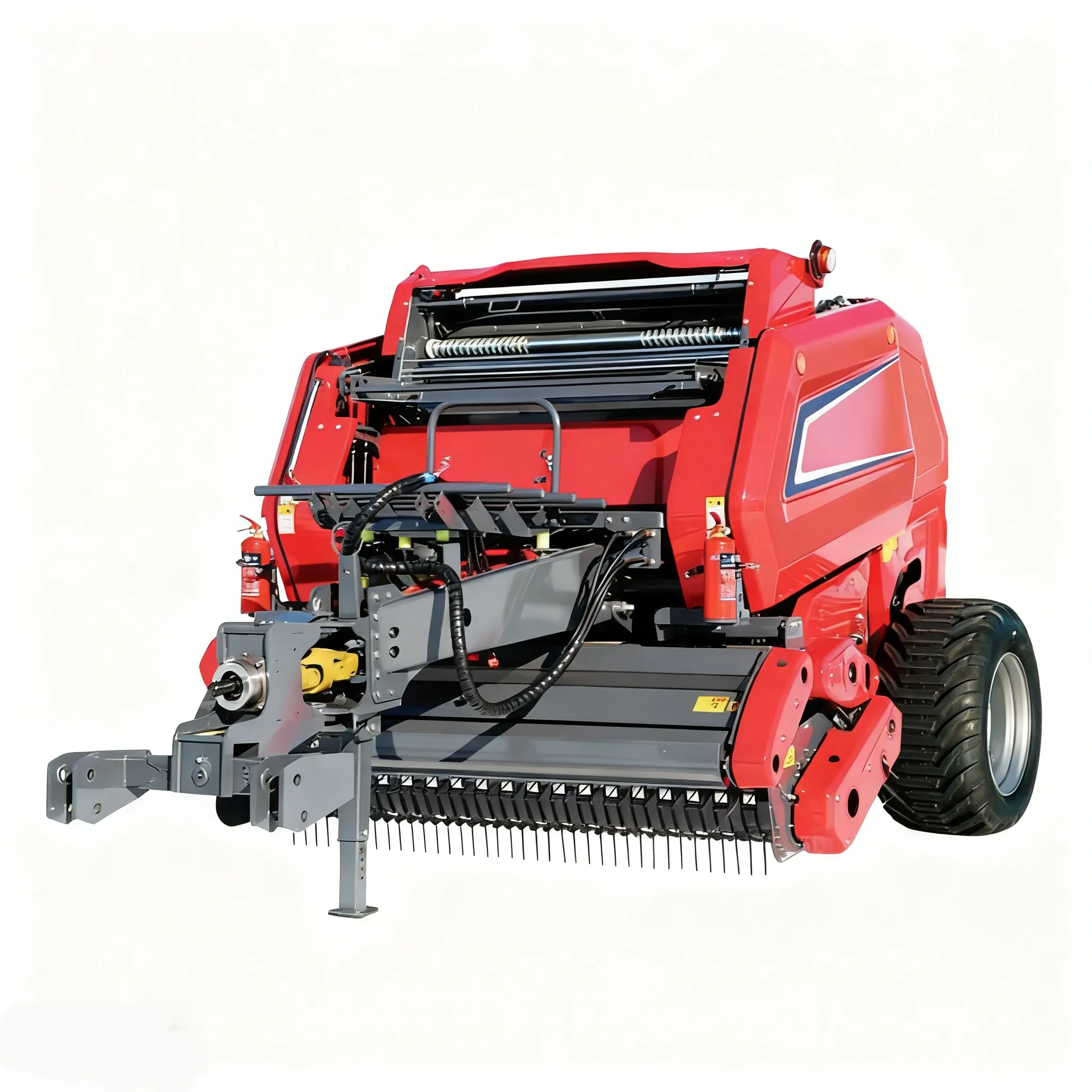
The 9YG-1.25A variable-chamber round baler handles chopped sorghum silage reliably at the high densities (180 to 220 kg/m³ DM) required for complete anaerobic conditions. Pair it with the 9YCM-850 bundling film wrapping machine set to 6 layers minimum — 8 layers recommended for storage beyond 9 months or in high-temperature storage conditions.
Section 3: Fermentation and Feeding
3.1 Fermentation Quality Indicators
Well-fermented sorghum silage has a clean, acidic smell with no ammonia or butyric notes, a uniform dark green to olive-brown colour, and a pH of 3.8 to 4.5 at opening. Fermentation should be complete by day 21 to 28. The main quality risk is aerobic deterioration at the exposed face after opening — sorghum silage is more prone to heating on the open face than corn silage due to its higher yeast count in the pre-ensiling material. Feed out each opened bale within 2 to 3 days and monitor face temperature.
3.2 Sorghum Silage in Cattle Rations
Sorghum silage typically delivers 8.5 to 10.5 MJ metabolisable energy per kg dry matter — 10 to 15% below well-made corn silage but 40 to 60% above good-quality grass silage. For beef growing systems targeting 0.8 to 1.2 kg/day weight gain, sorghum silage at 50 to 60% of the ration dry matter with a moderate concentrate supplement (1.5 to 2.5 kg/day) delivers commercially viable performance in drought-region beef systems where corn silage is too expensive or impossible to grow.
Frequently Asked Questions
Contact Us About Sorghum Silage Equipment
Share your crop type, annual volume, and tractor specification — we’ll specify the right baler for your operation.