product
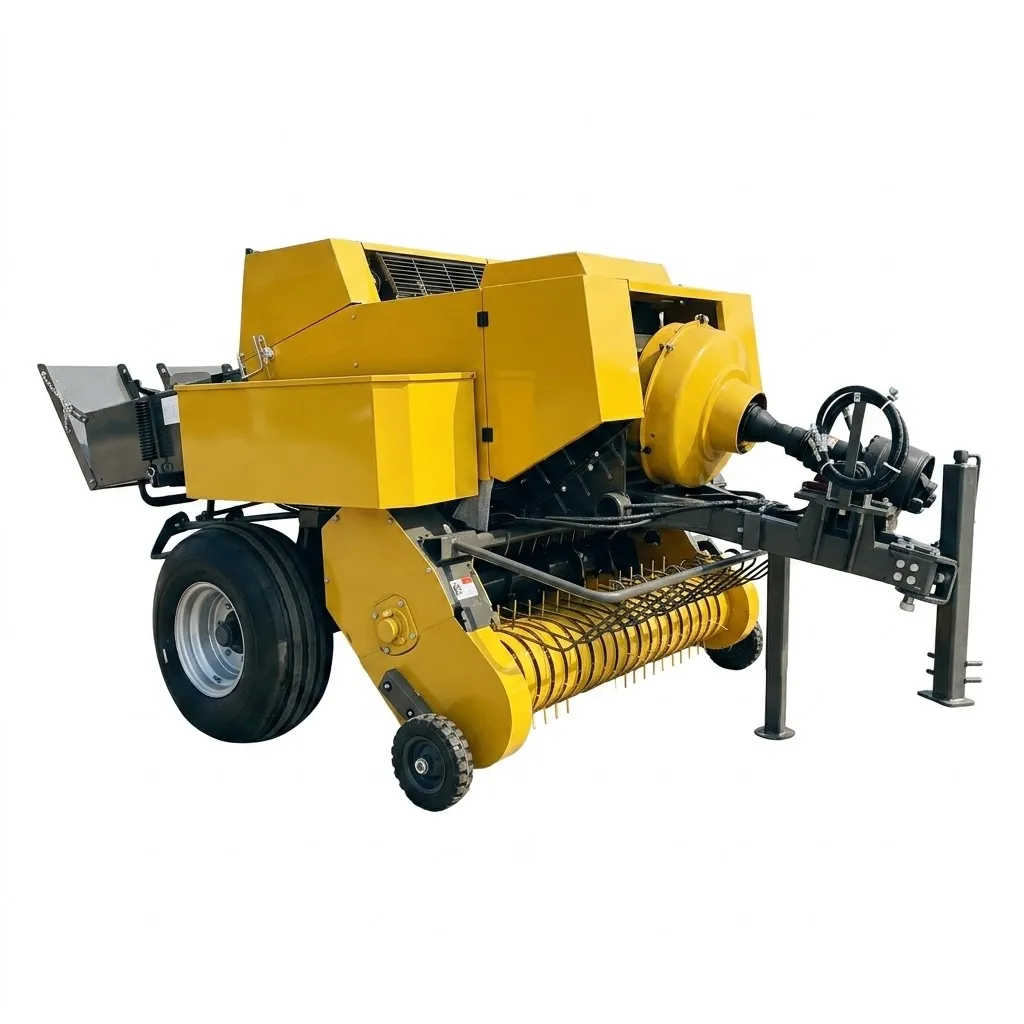
9YFS-2.2 Double-Compartment Square Hay Baler — 2 Bales Per Cycle, 4 Knotters, 2200mm
The 9YFS-2.2 is a double-compartment towed square baler producing two fully tied bales per plunger stroke through two parallel 460×360 mm compression chambers and four D-type automatic knotters. With a 2200 mm spring-tooth pickup and a minimum power requirement of ≥51.5 kW, it delivers maximum square bale throughput for high-volume straw contractors, large grain farms, and commercial fodder producers.
Two Bales Per Plunger Stroke — The 9YFS-2.2 Double-Compartment Square Baler for Maximum Field Throughput
In straw and hay baling, output per tractor hour determines the economics of the operation. For farms and contractors baling large areas under time pressure — post-harvest straw collection, high-volume hay contracting, or large-scale fodder production — the limiting factor is often not ground speed but how many bales the machine produces per hour at that speed. The 9YFS-2.2 addresses this directly: a double-compartment square baler with two parallel compression chambers operating simultaneously, producing two fully tied bales per plunger cycle rather than one.
The mechanical design that enables this is precisely what the model name describes: two 460×360 mm compression chambers running in parallel, each served by its own pair of D-type knotters — four knotters in total. A 2200 mm spring-tooth pickup and fork feeding mechanism deliver crop into both chambers simultaneously at the same ground speed as the single-chamber 9YF-2200. The power requirement steps up to ≥51.5 kW (approximately 70 hp minimum) to drive the doubled compression load, and machine weight rises to 3115 kg. What the operation gains is a doubling of bale output per unit of tractor time, fuel, and operator hours — the most significant throughput gain available in the 9YF series without adding a second machine. For context on how round and square forage balers compare in different situations, our guide covers the key factors.
Australia Ever-power Forage Balers Co., Ltd. supplies the 9YFS-2.2 direct from Charlton Industrial Area, with Australian spare parts stock for all four knotter assemblies and the dual-chamber feeder system components that define the machine's unique performance advantage.
Complete Technical Specifications
Full technical documentation including dual-chamber synchronisation specs, 4-knotter timing guide, and spare parts catalogue on request — contact our team.
When One Bale Per Cycle Is Not Enough — How the Double Chamber Changes the Economics
The single largest constraint in high-volume square baling operations is not the pickup, not the feeding, and not the tractor — it is how many bale cycles the machine can complete per hour. Ground speed determines how frequently the machine encounters windrow material; the compression chamber determines how many bales come out of each cycle. The 9YFS-2.2 doubles the latter without changing the former.
⏱️ Time Value of Baling Windows
Post-harvest straw collection windows are narrow — weather, field access, and replanting schedules all compress the available time. Every hour of baling time saved by doubling bale output per field pass is an hour that either reduces the seasonal harvest labour demand or allows more area to be baled within the same weather window. At scale, this time value is the primary economic argument for the 9YFS-2.2 over two single-chamber machines.
🚛 Tractor Hours and Fuel Per Bale
Tractor operating cost — fuel, service intervals, and operator time — is the largest variable cost in baling. Doubling bale output per tractor hour from the same machine halves the tractor cost per bale. The 9YFS-2.2 requires a tractor producing at least 51.5 kW rather than 36.8 kW, but the cost of running a 70 hp tractor versus a 50 hp tractor is substantially less than doubling the tractor hours at the lower power level to produce the same bale count.
📋 Contractor Revenue Per Day
For contractors billing by the bale, the 9YFS-2.2 doubles daily revenue potential from the same number of field hours — assuming the tractor and windrow supply keep pace. Where a single-chamber machine produces 600 bales per day, the dual-chamber machine produces 1200 from the same tractor and operator combination, with the additional revenue offsetting the higher machine cost within the season's run rather than over multiple years.
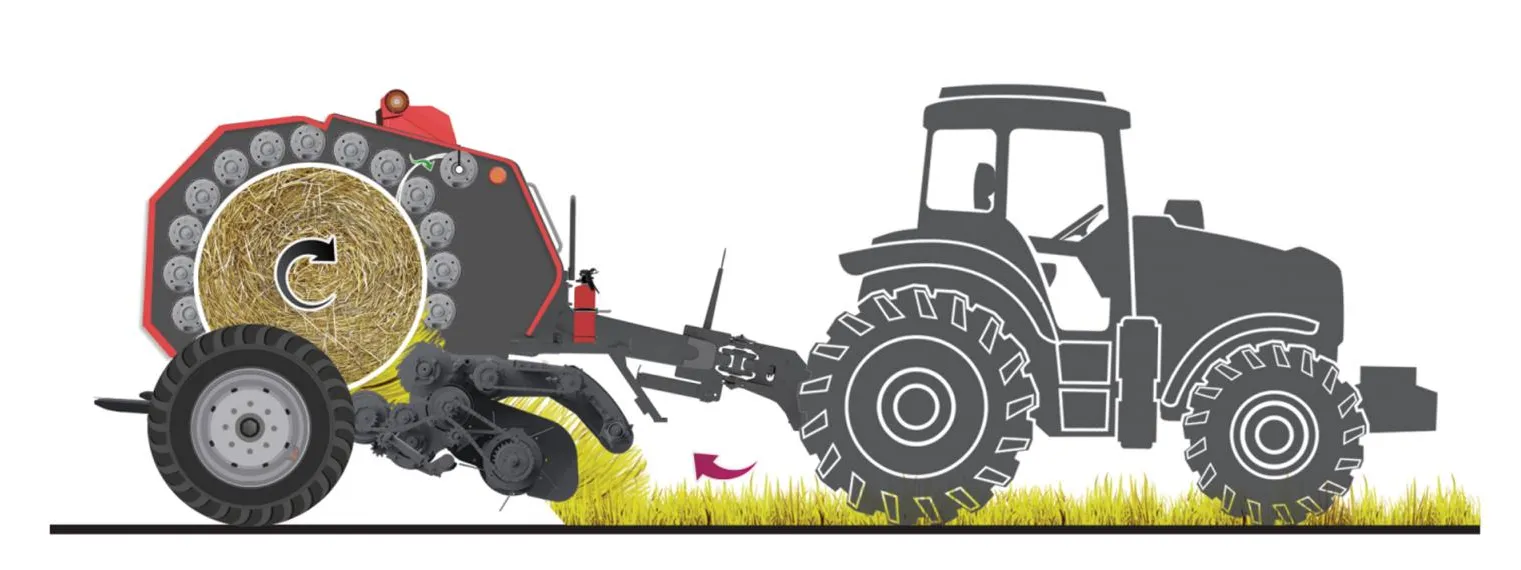
How the 9YFS-2.2's Dual System Works — Four Key Mechanisms
Running two compression chambers in parallel requires more than simply placing them side by side. Each chamber needs its own compression and tying system, and both must be synchronised through the same feeder and plunger drive. These are the four mechanical elements that make the dual-chamber design work reliably in field conditions.
Two Parallel 460×360 mm Compression Chambers — Simultaneous Operation
Both compression chambers share the same plunger drive and stroke timing — they operate simultaneously, receiving crop from the fork feeder and compressing it on the same plunger stroke. At the end of each compression cycle, both chambers release a fully tied bale simultaneously. The result is two bales deposited per plunger cycle across the full field run.
Bale consistency across both chambers
Because both chambers share the same compression stroke mechanism, bale density and dimensions are consistent between left and right outputs. The load on the fork feeder is divided between two chambers — each chamber receives approximately half the crop volume per cycle — which keeps the per-chamber feeding load at a level comparable to a single-chamber machine operating at the same ground speed.
4 × D-Type Knotters — Two Per Chamber, All Four Operating Each Cycle
Each of the two compression chambers is served by its own pair of D-type knotters — four knotters in total. All four activate simultaneously at the end of each compression cycle, completing the tie on both bales before the plunger returns. The D-type geometry is the proven field standard for heavy-duty square baling worldwide, producing a consistent, load-bearing knot that holds through transport and mechanical handling without the slip failures of lower-grade alternatives.
Four knotters means four daily inspection points
Running four knotters rather than two doubles the daily inspection workload for the tie system — but the inspection procedure for each knotter is identical. Before the first bale of each day, check bill hook timing, twine disc condition, and needle position on all four units. Carrying spare twine disc assemblies and needle assemblies for all four knotters in the tractor cab allows fast field repair if any single unit needs attention during a long day's run.
2200 mm Spring-Tooth Pickup + Fork Feeding to Both Chambers
The 2200 mm spring-tooth reel captures wide-cut windrows in a single pass — the same reel width as the 9YF-2200, giving the dual-chamber machine the same windrow capture efficiency as the widest single-chamber model in the range. The fork feeding mechanism then divides the incoming crop volume between the two chambers, delivering a metered charge to each in synchronisation with the plunger cycle.
Why the fork feeder suits the dual-chamber application
The fork feeder's discrete, stroke-synchronised charging action is well-matched to the dual-chamber layout — it delivers a controlled volume per stroke rather than a continuous flow, which makes equal division between chambers more mechanically manageable. An auger-fed system delivering continuous flow would require additional splitting mechanics to equalise crop distribution between two chambers; the fork design simplifies this by its inherent cycle-by-cycle metering.
≥51.5 kW Power Requirement — Why It Steps Up From the Single-Chamber Models
The 9YFS-2.2 requires ≥51.5 kW (approximately 70 hp) versus the 36.8 kW minimum of the single-chamber 9YF series. The additional power is needed to drive two simultaneous compression strokes — the plunger mechanism is working twice as hard per cycle to compress two bales rather than one. The 3115 kg machine weight (compared to 1950 kg for the 9YF-2200) reflects the doubled chamber structure and additional knotter assemblies.
Recommended tractor size for sustained heavy-crop operation
51.5 kW is the minimum; we recommend 75–100 hp for sustained operation in heavy corn straw or thick wheat straw windrows where peak compression loads are highest. Running at minimum power through heavy windrows risks PTO speed drop during the compression stroke, which reduces bale density in both chambers simultaneously. A 10–15% power margin above minimum ensures consistent compression quality across the full day's run.
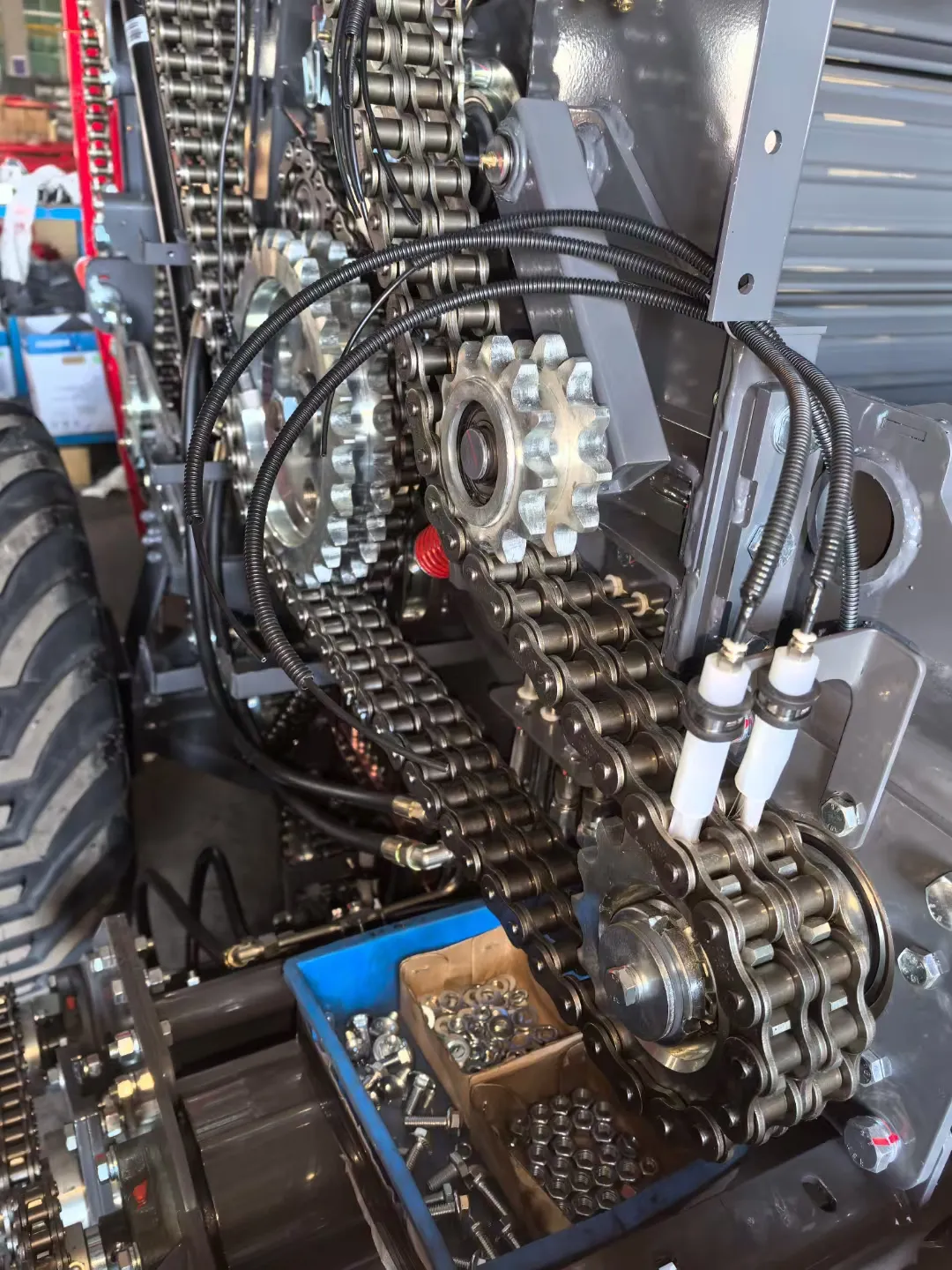
Where the 9YFS-2.2 Produces Its Best Return
The 9YFS-2.2's doubled throughput advantage scales with bale volume — the more bales an operation produces per season, the more strongly the dual-chamber economics favour this machine over single-chamber alternatives. Below are the applications where it delivers its strongest return.
High-Volume Commercial Straw Contractors
Contractors supplying straw to paper mills, mushroom substrate producers, biomass energy plants, or livestock bedding operations under volume contracts benefit most directly from the 9YFS-2.2's throughput advantage. Doubling daily bale output from the same tractor-operator combination means contracts requiring 5000+ bales can be completed in half the field time — or twice the contract volume can be serviced in the same time with the same field crew.
Large Grain Farms — Post-Harvest Straw Collection
Large grain properties baling their own wheat, corn, or rice straw face the same narrow window pressure as commercial contractors. The 9YFS-2.2's ability to clear straw from large paddock areas in half the passes of a single-chamber machine is the difference between completing straw collection before the next crop planting window and being forced to burn or slash residue to meet land preparation schedules.
Large-Scale Fodder Producers
Operations producing oaten hay, mixed pasture hay, or lucerne in high volumes for domestic feedlot supply or export need baling machines that can keep pace with large mowing equipment covering hundreds of hectares per season. The 9YFS-2.2's dual-chamber throughput means the baler can service more mowing area per day, reducing the risk of hay being rained on between mowing and baling during volatile spring or autumn weather windows.
Export Hay Operations Supplying by the Container
Export hay suppliers filling 20-foot shipping containers are constrained by how quickly they can accumulate sufficient bale volume to load a container. Doubling baling throughput reduces the time between field cut and container departure — important for lucerne exporters where hay quality and leaf retention degrade with extended field exposure before baling.
→
→
→
→
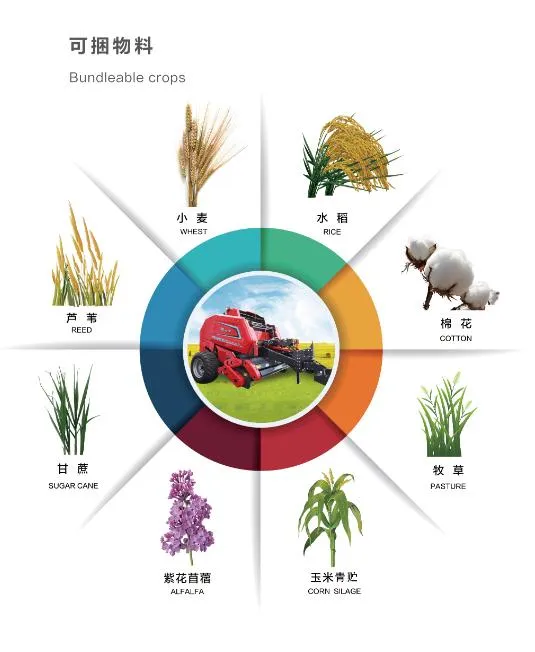
Running the 9YFS-2.2 at Full Dual-Chamber Output
The 9YFS-2.2 has more components than any single-chamber machine in the 9YF range — and more inspection points. These operating habits keep both chambers producing consistently and both knotter pairs tying reliably across the full day's run.
Inspect All Four Knotters Before Each Day
Four knotters means four daily inspection points — bill hook timing, twine disc condition, and needle position for each. At the scale the 9YFS-2.2 operates, a single missed tie mid-field leaves a loose bale that either requires manual tying or re-running. Carry a full set of spare knotter wear components — four twine discs and four needle assemblies — in the tractor cab. A 5-minute knotter field repair costs far less than a re-run of the full row.
Maintain Full PTO Speed in Heavy Windrows
In dense corn straw or thick wheat windrows, the dual compression load is at its highest. If PTO speed begins to drop under load, reduce ground speed immediately rather than allowing the drop to continue. PTO speed reduction in the 9YFS-2.2 affects both chambers simultaneously — both bales in the current cycle will be under-compressed if the stroke completes at reduced speed. A 75–100 hp tractor provides the right power buffer for sustained operation without this compromise.
Monitor Both Chamber Outputs for Symmetry
After the first few bales of each day, check that bales from both chambers are approximately the same weight and length. Consistent asymmetry — one chamber consistently producing longer or heavier bales than the other — indicates unequal crop distribution from the fork feeder between the two chambers. Address feeding adjustment before committing to the full day's run, as the imbalance will compound across thousands of bale cycles.
Bale Strictly Below 20% Moisture
Elevated moisture affects rope-tying reliability and increases the load on all four knotters simultaneously. At the throughput rate the 9YFS-2.2 operates, a batch of elevated-moisture bales tied through overloaded knotters risks a cascade of tie failures across a morning's run. Use a hay moisture meter. A decision to wait 24 hours for better curing is always cheaper than a day of retying or re-running bales.
Grease All Points at Every Fuel Stop
At 3115 kg, the 9YFS-2.2 carries more bearing and pivot points than any machine in the 9YF range. Greasing at every refuelling stop — not once per day — keeps all points protected through Australian summer harvest temperatures. Dry bearing failure in a dual-chamber machine during peak harvest typically requires the machine off-field for at least a day; the 5-minute greasing stop at each fuel fill is the most cost-effective insurance against this.
Clear Both Chambers at Shutdown
Residual straw compressed overnight in either chamber dries into a hard plug by morning, resisting the first compression stroke and requiring manual clearing before the day's run can start. After the last bale of each day, run the machine briefly to push any remaining material through both chamber exits before shutdown. With two chambers to clear rather than one, the overnight residue problem doubles in severity if left unaddressed — this shutdown step is worth the extra 5 minutes every day.
Dual-Chamber Square Baler Technology — Factory-Direct, with Australian Parts Stock for All Four Knotters
Australia Ever-power Forage Balers Co., Ltd., Charlton Industrial Area. About our business and supply model.
Factory-Direct Price for a Premium-Spec Machine
A double-compartment square baler with four D-type knotters, 2200 mm pickup, and 3115 kg build weight is a premium-specification machine that commands a substantial price in European-brand distribution channels. Ever-power's direct supply to Australia removes the importer-distributor-dealer margin stack. What you pay reflects the machine's manufacturing and delivery cost — not its position in a tiered product range with accumulated margin at every tier.
Australian Stock for All Four Knotter Assemblies
D-type knotter components — bill hooks, twine discs, needle assemblies — for all four knotter units on the 9YFS-2.2 are held in Australian stock at Charlton Industrial Area. At the throughput rate this machine operates, a knotter component failure during harvest is an urgent repair. Having Australian-stocked parts means a same-week repair rather than a multi-week international freight delay that could cost a significant portion of the seasonal contract.
Dual-Chamber Setup Support — Getting Both Chambers Balanced
Our Australian team provides first-season guidance on dual-chamber balancing, fork feeder synchronisation, four-knotter timing adjustment, and tractor power matching for specific crop conditions. The 9YFS-2.2 has unique setup requirements compared to single-chamber machines — we support that setup as part of the machine purchase relationship, not as a separate service. Contact us at [email protected] or through our enquiry form.
Frequently Asked Questions
Common questions from high-volume straw contractors, large grain farms, and commercial hay producers evaluating the 9YFS-2.2.