
Corn Stover Baling: How to Collect and Store Corn Stalks After Harvest
Post-harvest timing windows, moisture targets, pre-shredding vs. direct baling, silica wear management, and the multiple market channels for baled corn stover in China, India, and Southeast Asia.
From Field Burning Liability to Livestock Feed Asset
Corn stover — the stalks, leaves, husks, and cobs that remain in the field after grain harvest — is the world’s largest single category of underutilised crop residue. China’s annual corn grain harvest of approximately 260 million tonnes generates 200 to 300 million tonnes of stover. The United States produces a further 180 to 200 million tonnes. Brazil, India, and Southeast Asian corn-growing nations add tens of millions more. For decades, the default management of this enormous biomass resource was burning: cost-free, labour-minimal, and immediate. In China, an estimated 150 to 200 million tonnes of stover were burned annually in open fields before the 2014 national prohibition on open-field residue burning.
The burning prohibition transformed corn stover from a disposal cost into a commercial opportunity — or, for those who ignored it, an enforcement liability. China’s Ministry of Ecology and Environment reported over 2.1 million penalty incidents involving open crop residue burning between 2016 and 2022. The fines are financially significant (¥200 to ¥2,000 per incident, with higher penalties for repeat violations during restricted periods), but the reputational and administrative consequences of repeat violations in rural China’s increasingly regulated agricultural sector are equally important to farmers.
Baling converts corn stover from a problem into an asset. At 5 to 7% crude protein and 45 to 55% total digestible nutrients (dry matter basis), corn stover is a genuine roughage — not a high-quality feed, but a genuinely functional one for the roughage role in beef cattle and beef buffalo rations. Sold to neighbouring beef farms at ¥80 to ¥150 per bale in the major corn-producing regions, baled stover generates revenue from material that previously generated compliance risk. Our article on what silage is and how it differs from hay covers the broader context of crop residue preservation options.

Section 1: Post-Harvest Timing and Moisture Management
1.1 The Baling Window After Grain Harvest
Corn stover quality and baling suitability change significantly in the days following grain harvest. At the point of combine passage, stover moisture varies by hybrid, region, and weather — typically 30 to 45% in most Chinese corn-growing environments in September and October. This is above the safe dry baling moisture threshold of 18 to 22%, requiring field drying before baling. The window for optimal baling is between 4 and 10 days after grain harvest, when field drying has reduced moisture to 18 to 28% in most conditions.
| Dagen na de oogst | Typical Stover Moisture | Ruw eiwit | Quality Status | Actie |
|---|---|---|---|---|
| 0–2 dagen | 35–48% | 6–7% | Too wet — heat/mould risk | Wait, rake to speed drying |
| 3–6 days | 22–35% | 5.5–6.5% | Drying — monitor daily | Rake if still above 28% |
| 5–9 days ✓ | 16–25% | 5–6.5% | Optimal baling window | Bale immediately |
| 10–14 days | 12–20% | 4.5–6% | Acceptable, shattering risk | Bale within 2 days |
| >14 days | <15% | 4–5% | Declining — leaf shatter | Emergency baling only |
The optimal window is narrow, and weather is the controlling variable. A rain event during the drying period (common in October in Heilongjiang and Jilin provinces) re-wets the stover and resets the drying clock. Operations that can mobilise baling equipment within 24 to 48 hours of reaching the optimal moisture window capture the best quality; those who wait for convenient scheduling may find the stover has dried past 15% and leaf shatter during pickup is removing the most nutritious fraction of the material.
1.2 The Effect of Rain on Cut Stover Quality
Rain on cut corn stover leaches water-soluble compounds — primarily soluble sugars and soluble protein fractions — from the leaf tissue at a measurable rate. Research in Chinese corn-producing regions has shown that a single 20 mm rainfall event on standing stover 5 to 7 days post-harvest leaches 3 to 6% of total dry matter value from the leaf fraction. Repeated rainfall events (common in autumn in northern and northeastern China) can reduce the crude protein content of stover from 6.5% to below 4% before baling is completed. Prioritising baling over other field operations in the post-harvest window directly protects feed value.
Section 2: Equipment and Baler Configuration for Corn Stover
2.1 The Silica Wear Problem
Corn stalks contain 1 to 3% silicon dioxide (silica) by dry matter — the same compound that makes glass. This silica is distributed throughout the stalk surface tissue as discrete phytolith particles, giving dried corn stalks their characteristic shiny, glassy appearance. For baler components, silica is a progressive abrasive — every pass of a stover windrow through the pickup, bale chamber, and net wrap application mechanism deposits silica particles on metal surfaces and accelerates wear beyond normal working rates.
Operations baling significant volumes of corn stover should budget for 40 to 60% higher wear-part replacement frequency than when running the same baler on grass or ryegrass silage crops. Specifically: pickup tine replacement at 60 to 70% of normal interval, chamber roller re-surfacing at 50 to 60% of normal interval, and net wrap knife and clamping mechanism inspection at every 50 to 75 bale intervals. Using a manufacturer-approved stover-service lubricant schedule — typically with increased greasing frequency on all pickup and chamber bearing points — significantly reduces the silica-driven wear rate on critical components.
2.2 Pre-Shredding vs. Direct Baling
Corn stover can be baled in two ways: directly as it lies in the combine discharge swath (direct baling) or after a separate pass with a flail shredder or disc chopper that breaks the stalks into 5 to 15 cm fragments (pre-shredded baling). The two approaches have very different quality, efficiency, and equipment wear outcomes:
| Factor | Direct Baling (Whole Stalk) | Pre-Shredded Baling |
|---|---|---|
| Equipment required | Baler only | Shredder + baler |
| Bale density | Low — air gaps between stalks | High — 30–45% more DM per bale |
| Chamber plugging risk | High in tangled windrows | Low — consistent particle size |
| Wear on pickup tines | High — rigid stalks damage tines | Lower — fragmented material |
| Feed quality for cattle | Lower — poor chew reduction | Better — shorter particle length |
| Bales per hectare | More bales, less DM each | Fewer bales, more DM each |
Pre-shredding is the recommended approach for any operation producing more than 100 bales per season. The additional shredder pass is offset by the higher DM per bale, lower equipment wear, and better feed quality. In China, combined shredder-baler units that perform both operations in a single pass are increasingly available from domestic manufacturers and are the standard for commercial-scale corn stover baling contractors.
2.3 Key Baler Settings for Corn Stover
Higher tine clearance than grass silage baling is required to prevent soil and stubble contamination. Soil in stover bales introduces silica, soil microorganisms, and grit that both reduce feeding quality and accelerate chamber wear beyond the silica wear already present from the stover itself.
Stover windrows are structurally variable — dense mats of tangled stalks alternating with gaps. Constant slow forward speed maintains even feed rate better than variable speed, reducing the risk of chamber blockage in dense sections.
Target 140 to 180 kg DM/m³ bale density. Higher pressure produces denser, more weathering-resistant bales but increases chamber stress and wear on pre-shredded stover that is more abrasive at high compression than whole-stalk material.
Net wrap maintains bale shape under the deformation stress of stover’s variable-density content and is essential for bales handled with mechanical equipment. Twine-tied stover bales frequently deform asymmetrically and become difficult to handle with standard bale spikes.
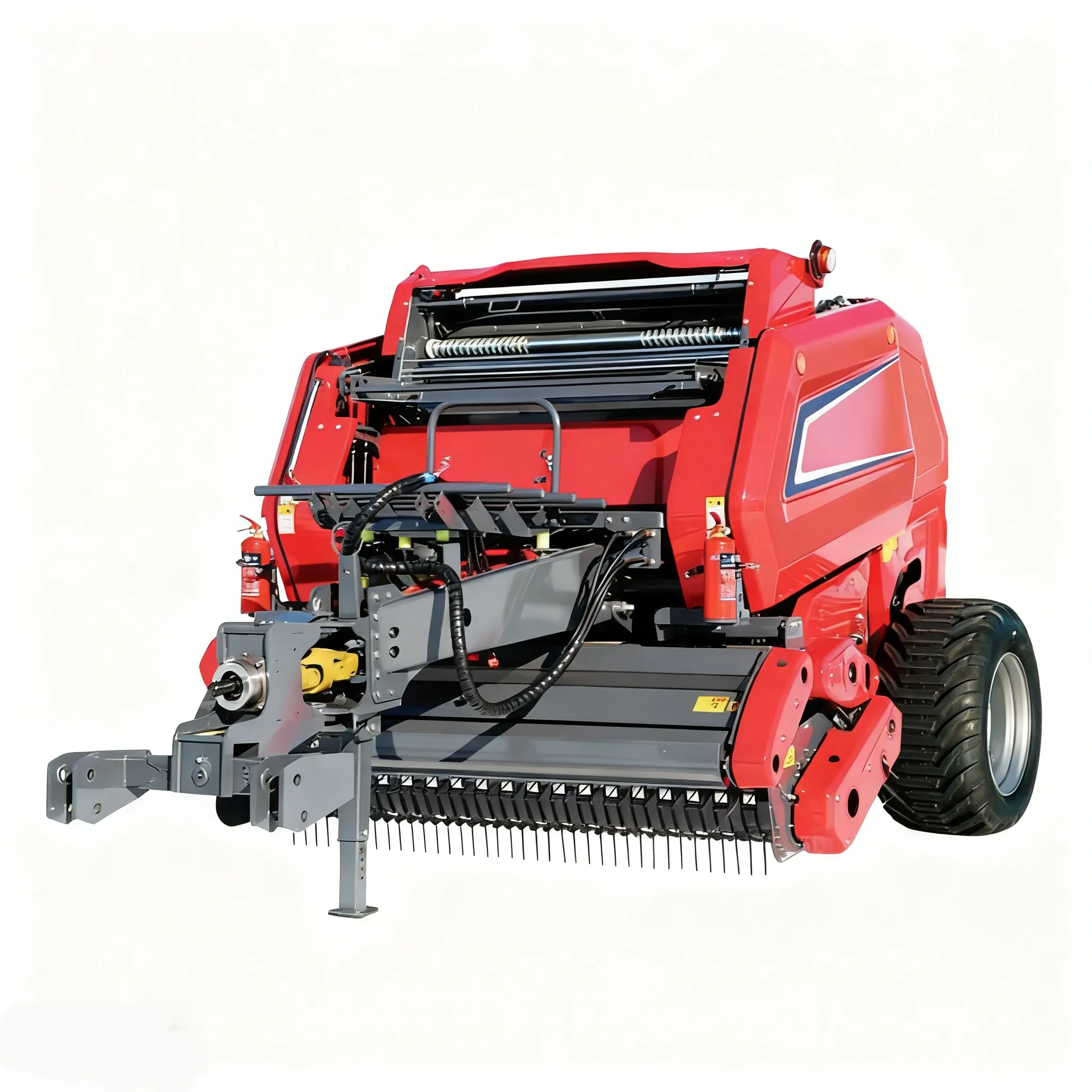
De 9YG-1.25A ronde balenpers met variabele kamer handles pre-shredded and whole-stalk corn stover in standard configurations. For high-volume contractor operations covering 200+ hectares per season, the 9YG-2.24D S9000 Beyond ronde balenpers provides the higher throughput and chamber capacity needed for efficient operation in large stover windrows.
Section 3: Corn Stover in Beef Cattle Rations
3.1 Nutritional Value and Appropriate Ration Role
Corn stover at 15 to 20% moisture has the following typical nutritional profile on a dry matter basis: crude protein 5 to 7%, neutral detergent fibre (NDF) 65 to 75%, acid detergent fibre (ADF) 40 to 50%, total digestible nutrients (TDN) 45 to 55%. This nutritional profile places corn stover firmly in the structural roughage category — adequate for maintaining dry beef cows and stocker cattle, insufficient as the sole feed for any productive ruminant class without significant supplementation.
In the beef production systems of China’s Heilongjiang, Liaoning, and Inner Mongolia provinces — where corn stover is the most abundant and affordable roughage — it is commonly included at 30 to 50% of the total mixed ration dry matter for growing beef cattle, balanced with corn grain, soybean meal or cottonseed meal for protein, and corn silage or grass silage for additional energy and digestibility. At this inclusion rate, stover provides the dietary fibre needed for normal rumen function while the energy-dense ingredients provide the metabolisable energy needed for growth. Daily weight gains of 0.8 to 1.2 kg per head are achievable in well-managed beef growing operations where corn stover is 35 to 45% of the ration with appropriate supplementation.
3.2 Urea Treatment — When It Makes Sense
Urea treatment (ammoniation) of corn stover can raise crude protein from 5 to 7% to 9 to 12% and improve neutral detergent fibre digestibility by 8 to 15 percentage points. The process involves applying a 3 to 5% urea solution (dissolved in water at 40 to 50 litres per tonne of stover) by spray or injection, then sealing the stover mass in a film covering for 21 to 28 days. The urea hydrolyses to ammonia, which reacts with cell wall phenolic compounds and ester linkages in a way that improves fibre digestibility and simultaneously supplies the treated stover with non-protein nitrogen that rumen microbes convert to microbial protein.
Urea treatment of bales (as opposed to bulk piles) is practical at farm scale: bales are spray-inoculated with urea solution at the time of baling and immediately wrapped with silage film for the 21 to 28 day reaction period. The capital investment is minimal — a backpack spray or a simple sprayer mounted on the tractor rear linkage — and the labour requirement is low. For operations where protein supplement (soybean meal, rapeseed meal) is expensive or difficult to source, urea treatment of corn stover bales is one of the most cost-effective feed quality improvements available in the Chinese and Indian beef production context.
Common Mistakes in Corn Stover Baling
Corn stover baled at above 30% moisture does not have sufficient structure to hold its own heat during the respiratory phase that follows baling — it compresses into a wet mass that achieves core temperatures above 60°C within 72 hours and initiates mould at the centre. The mould then spreads outward to the accessible surface, rendering the bale unpalatable and potentially mycotoxin-contaminated within 3 to 4 weeks. Allow a minimum of 4 to 6 days of field drying after combine passage before checking moisture and considering baling.
Corn stover leaf and husk material becomes brittle once moisture drops below 12% and shatters on contact with pickup tines, rakes, and baler components. Each pass of dry stover material through the baler pickup removes 8 to 20% of the leaf fraction from the windrow by shattering. Since leaves carry 2 to 3 times the crude protein concentration of the stalk, this fraction loss is disproportionately damaging to the nutritional value of the bale. Bale within 10 days of grain harvest whenever moisture allows.
Heavy corn stover windrows — particularly from high-yielding hybrids in dense populations — have a surge-and-gap structure that causes uneven feed rate at the baler pickup. Operating at normal grass silage baling speeds (8 to 12 km/h) in this material produces repeated chamber over-loading peaks, resulting in asymmetric bales, pickup blockages, and accelerated pickup tine wear. Reduce speed to 4 to 6 km/h and maintain consistent forward pace rather than accelerating and braking with the windrow density variation.
Corn stover has multiple potential market channels beyond simple roughage sales: mushroom cultivation substrate in eastern China’s mushroom industry, biomass boiler feedstock for local industrial heating operations, composting input for vegetable greenhouse operations, and biogas feedstock for rural biogas digesters. The price per tonne varies significantly by channel — biomass and mushroom substrate applications may command 50 to 120% higher prices than roughage markets in some regions. Research local demand in each channel before committing all production to the lowest-value roughage market.
Veelgestelde vragen
Discuss Your Corn Stover Baling Programme
Tell us your operating area, available tractors, and target market — we’ll help specify the right baler configuration for corn stover collection at your scale.