
The Core Decision: What Each Configuration Actually Involves
Understanding Exactly What You Are Comparing
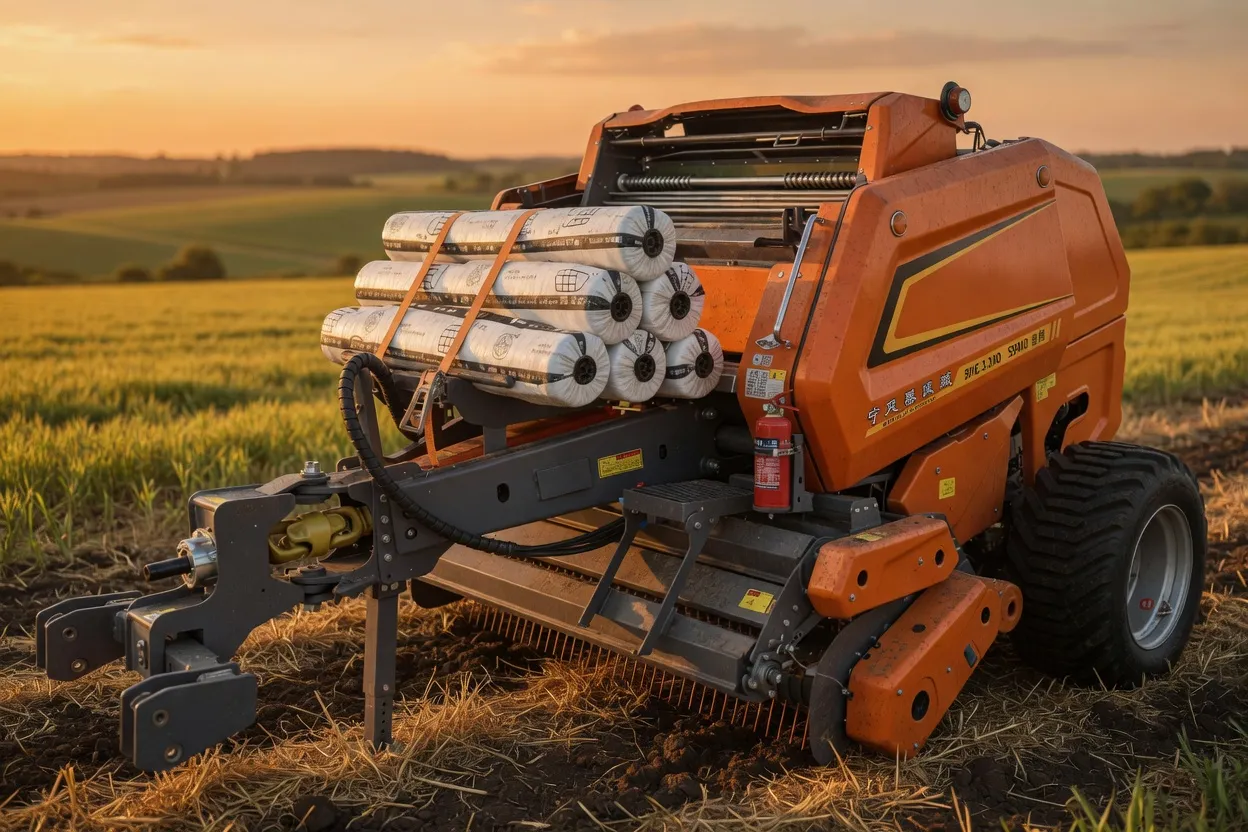
A baler-wrapper combination — sometimes called an integrated or combi unit — is a single machine that bales and wraps each round bale in one continuous sequence, without the bale leaving a controlled environment between the two processes. The bale is formed in the chamber, transferred directly to the integrated wrapping table, wrapped with stretch film while still in contact with the machine, and then deposited on the ground fully wrapped and sealed. The entire process from open crop to sealed bale takes 60–90 seconds per bale, and critically, the interval between baling and wrapping is measured in seconds rather than hours.
A separate baler and wrapper configuration involves two distinct machines operating independently. The サイレージベーラー produces unwrapped bales that are left in the paddock in rows, and a second machine — either a towed satellite wrapper, a transport-and-wrap unit, or a stationary farm wrapper — subsequently collects or processes those bales, applying the stretch film wrapping as a separate operation. This creates an interval between baling and wrapping that can range from 30 minutes to several hours depending on the operational setup, equipment availability, and distance from the paddock to the wrapping site.
Both configurations are used extensively in Australian silage operations and both produce excellent silage when properly managed. The question is not which system is objectively better — it is which system is better matched to the specific scale, production pattern, labour resources, and capital position of a particular operation. The comparison below covers each dimension where the two systems genuinely differ in ways that affect the outcome of that decision.
Silage Quality: Where the Two Systems Differ Most
The Baling-to-Wrapping Interval and Its Fermentation Consequences
The most significant quality difference between the two configurations is the time between baling and wrapping. This interval matters because every minute a freshly baled unwrapped silage bale is exposed to oxygen, aerobic microbial activity is consuming dry matter, generating heat, and allowing yeasts and moulds to establish colonies that persist into the fermentation period. A bale wrapped within seconds of formation has a fundamentally different starting point for fermentation than one wrapped two hours later — even if both were baled from the same windrow at the same moisture.
Research consistently shows that the dry matter losses in the interval between baling and wrapping are not trivial. At warm ambient temperatures (above 20°C, common in Australian conditions at typical silage cutting times), unwrapped silage bales can lose 1–2% of dry matter per hour of exposure. A two-hour wrapping delay at 25°C therefore represents 2–4% dry matter loss relative to an immediately wrapped bale — before the fermentation period even begins. For a 250 kg DM bale, that is 5–10 kg of dry matter that is gone before the bale enters storage.
The combination configuration eliminates this loss almost entirely — the wrapping delay is 30–60 seconds rather than minutes or hours. This is the single strongest quality argument for the integrated approach, particularly for high-value crops (lucerne, clover-rich pastures) where dry matter and protein losses in the pre-wrapping period are most economically significant. For operations producing silage for high-production dairy cows where every percentage point of digestibility matters, the quality argument for combination systems is compelling regardless of the other trade-offs.
For separate machine operations, the standard mitigation is to wrap as quickly as possible after baling — targeting within 2–4 hours of the last bale in each paddock. This is achievable with good operational organisation and a wrapper capacity that matches baler output. Separate systems managed with discipline can produce silage quality that approaches combination-system results — but they require that discipline consistently, whereas the combination system eliminates the need for it by design. For technical guidance on the 9YCM-850 包装ユニット and the full Ever-power range, contact our Charlton team.
Throughput: Bales Per Day and Harvesting Window Efficiency
How Each Configuration Performs Under Production Pressure
Throughput — the number of bales produced and sealed per day — is where the separate machine configuration typically has the advantage, provided adequate wrapper capacity is available. A standalone baler can run continuously while the wrapper operates independently, with no mechanical dependency between the two operations. When the baler produces a bale every 3–4 minutes in a good silage windrow, a day’s baling session can produce 120–150 bales from the baler alone. A single satellite wrapper operating simultaneously can process approximately 60–80 bales per day, meaning two wrappers or one fast-cycle wrapper are needed to match the baler’s output in intensive operations.
The combination machine has a longer cycle time per bale because baling and wrapping happen sequentially rather than simultaneously — a combination unit typically produces 40–60 wrapped bales per day at operating speeds appropriate for silage. For a farm producing 80–100 bales per cutting, this throughput is entirely adequate and a single combination unit handles the entire process. For a farm producing 300–400 bales per cutting, a combination unit’s throughput may be a limiting factor if the weather window is tight, whereas two standalone balers with two wrappers operating simultaneously could manage the same volume in a shorter window.
The weather-window dimension is particularly relevant in Australian conditions. If the available good-weather baling window is two days, a system that can produce 100 wrapped bales per day is adequate for a 200-bale cutting; a system limited to 50 per day requires four days of good weather for the same cutting. Operations in high-rainfall regions or with large silage areas need to consider whether the combination system’s throughput ceiling creates a weather-window risk that standalone systems with matched wrapper capacity would avoid.
Labour Requirements: Operators, Coordination, and Logistics
How Each System Uses — and Saves — People
Labour is one of the clearest practical advantages of the combination system for smaller operations. A single operator running a combination unit manages the entire process from windrow to sealed bale — no coordination, no second machine, no bale transport logistics between baling site and wrapping site. For family farms or operations that regularly struggle to find a second skilled operator for wrapping, this single-person capability is a significant practical advantage that affects whether the silage campaign actually happens on time.
Separate machine configurations require at minimum two operators working simultaneously to achieve the best quality outcome — one driving the baler and one operating the wrapper — plus potentially a third person handling bale transport if the wrapper operates at a fixed site rather than in the paddock. For commercial contractors, this two-to-three operator model is normal and economical because the scale of operation justifies the labour cost. For owner-operators without contractor relationships, the logistics of organising a second operator for every silage cutting day adds coordination overhead that the combination system eliminates.
The labour advantage of combination systems also applies to the physical work of bale handling — which is significant. In a separate system, unwrapped bales must be transported from their dropping position in the paddock to the wrapping site, then transported again from the wrapping site to the storage site. Each of these moves involves a tractor and loader and carries a risk of bale damage. In a combination system, the bale goes from windrow to fully wrapped in one location, and needs only one handling movement to the storage site. This reduction in bale handling is a genuine labour and equipment wear saving that compounds over large volumes.
Capital Cost: Purchase Price, Depreciation, and Value
What Each Configuration Costs to Own and Operate
The capital cost comparison is nuanced. A combination baler-wrapper unit has a higher initial purchase price than a standalone baler alone, but lower total capital than a standalone baler plus a dedicated satellite wrapper of equivalent quality. The combination machine effectively amortises the wrapper cost against the baler purchase, creating a more capital-efficient entry point for operations that need both functions. For farms that currently own a good baler and need only to add wrapping capability, purchasing a standalone wrapper is the lower initial outlay — but for operations making a complete system investment from scratch, the combination unit may represent better value per function.
Maintenance and repair costs differ meaningfully between the two approaches. A combination machine is a single complex unit with both baling and wrapping mechanical systems in one frame — when it requires service or repair, the entire system is unavailable. A separate baler and wrapper have independent availability — if the wrapper requires service, the baler can continue producing unwrapped bales that are wrapped when the wrapper returns. For commercial operations in the middle of a cutting campaign, having redundancy in system availability can have significant operational value that isn’t captured in purchase price comparisons.
Depreciation and residual value are roughly comparable between configurations — both systems depreciate primarily on age and hours. Film consumption is the same in both configurations for equivalent wrap specifications (same diameter, same layers). The ongoing consumable cost difference therefore relates to film roll efficiency, which is broadly comparable across modern machines of both types. The key ongoing cost difference is usually fuel — a combination unit typically uses more fuel per bale than a standalone baler because the wrapping function requires additional mechanical work that adds to tractor fuel consumption during the wrapping cycle.
Bale Handling and Film Damage Risk
How Configuration Affects the Physical Integrity of Wrapped Bales
Film damage is one of the most underestimated silage quality risks in typical Australian operations. Every time a wrapped bale is handled — picked up, transported, stacked — there is a risk of film puncture from loader tine contact, hard edges, or rough stacking surfaces. Film punctures that are not detected and repaired become oxygen infiltration points that cause localised spoilage that can extend significantly beyond the visible damage point. In a combination system, the bale is wrapped in the paddock and then moves only once — to the storage site — which means a minimum of one handling event after wrapping. In a separate system, the bale may be handled two to three times after wrapping: from wrapping site to transport, from transport to storage, and to the final stack position.
The combination system also avoids the risk of film damage that occurs when bales are dropped by the standalone baler and roll on rough ground before wrapping. Unwrapped bales dropped on rocky paddocks or rough stubble develop surface damage points that become film adhesion challenges during subsequent wrapping — the film spans rather than conforms to the damaged surface, creating micro-pockets. The combination unit deposits the bale directly onto the wrapping mechanism without a drop event, maintaining the bale surface integrity for better film adhesion.
Side-by-Side Comparison: All Key Factors
A Complete Reference for the Decision
| Factor | Combination Unit | Separate Baler + Wrapper |
|---|---|---|
| Bale-to-wrap interval | 30–60 seconds ✅ | 30 min – several hours |
| Silage quality potential | Maximum ✅ | High (if wrapped promptly) |
| Daily throughput (bales) | 40–60 bales | 80–150+ bales ✅ |
| Operators required | 1 person ✅ | 2–3 people |
| Capital cost (complete system) | Lower (1 machine) ✅ | Higher (2 machines) |
| System redundancy | Single point of failure | Independent units ✅ |
| Bale handling events post-wrap | 1 (to storage) ✅ | 2–3 |
| Field logistics complexity | Simple ✅ | Moderate to complex |
| Suitable for small volumes (<150 bales/year) | Yes ✅ | Less efficient |
| Suitable for large volumes (>400 bales/year) | Throughput limited | Yes ✅ |
Which Configuration Is Right for Your Operation?
Matching the System to the Farm Profile
✅ Choose a Combination Unit If:
- Annual silage production is under 200 bales
- Only one operator is regularly available
- Silage quality and minimal DM losses are the top priority
- High-value crops (lucerne, clover) are a significant proportion
- Capital budget favours a single complete system purchase
- Field logistics simplicity is important
- Minimal bale handling events are desired (film damage reduction)
✅ Choose Separate Machines If:
- Annual production exceeds 300–400 bales
- Multiple operators are reliably available
- Throughput within narrow weather windows is critical
- The baler is also used extensively for hay baling
- System redundancy is valuable (commercial operations)
- Bales are produced for custom work or contracting
- Existing baler is already owned and wrapper is the addition needed
Ever-Power: Equipment for Both Configurations
Standalone Balers, Wrappers, and Integrated Units — the Complete System Range
Regardless of which configuration suits your operation, the Ever-power range has the right components. For separate configurations, the S9000 series round balers pair with the 9YCM-850 bundling and film wrapping unit — a purpose-designed satellite wrapper matched to the bale sizes and output rates of the Ever-power baler range. The 9YCM-850 wraps standard round bales with adjustable overlap and layer count settings, operates with a single operator, and is designed for the sustained wrapping rates needed to keep pace with a high-throughput standalone baler. For operators evaluating a サイレージベーラー販売中 in Australia or planning a complete system upgrade, the チャールトンチーム provides system design advice matched to your operation’s bale volume, labour availability, and quality priorities.
Not Sure Which System Suits Your Operation?
Get System Design Advice from Our Team
Charlton Industrial Area, Australia — baler-wrapper system matching for every scale of Australian silage operation.

よくある質問
Common Questions About Baler-Wrapper System Choice