
The Fundamental Mechanical Difference
How Fixed and Variable Chamber Designs Build a Bale Differently
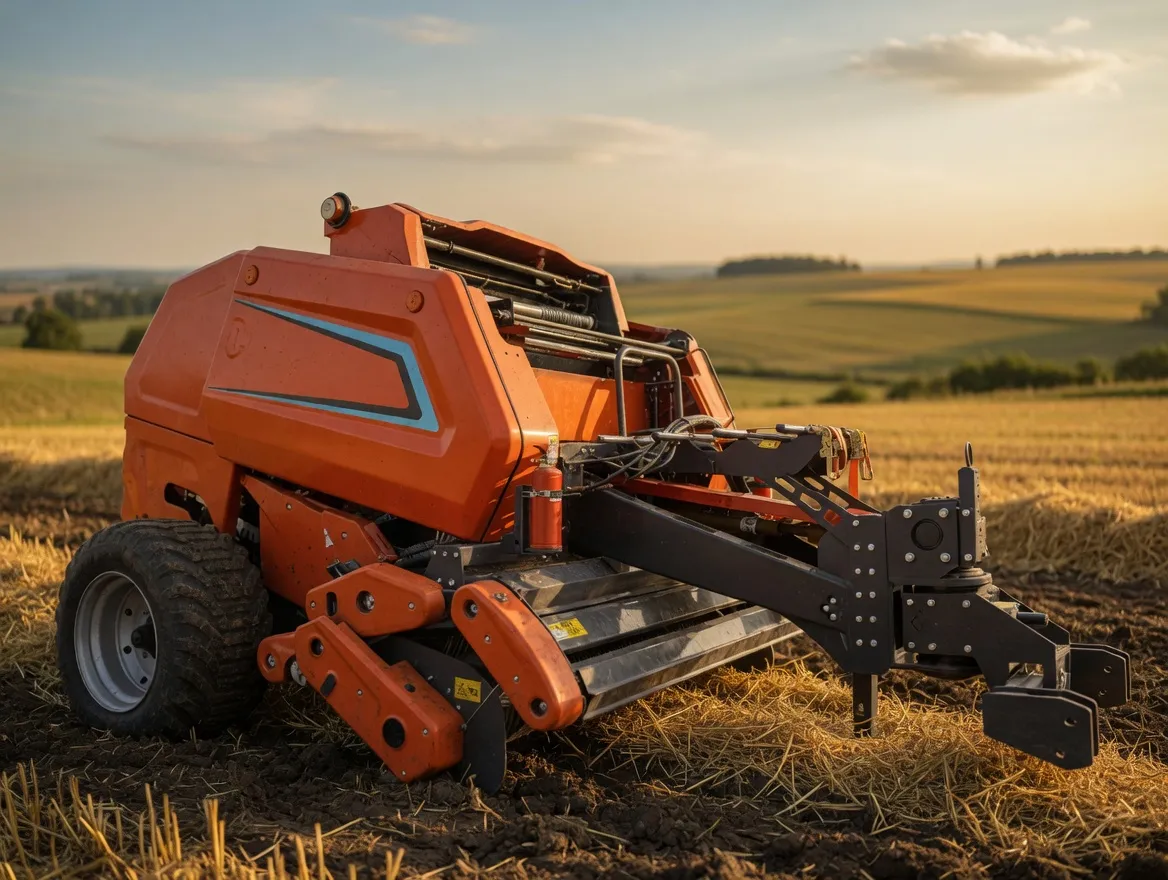
In a fixed chamber prasa okrągła, the bale forms inside a chamber bounded by a series of fixed rollers or a belt/roller combination that does not change geometry during the bale-building cycle. The chamber is always the same diameter, and as crop is fed in, it accumulates and rotates within this fixed space until the chamber is full. Density in a fixed chamber is primarily determined by how much material is packed into the fixed volume — the operator has limited ability to increase density beyond what the chamber geometry allows. All bales from a fixed chamber baler are essentially the same diameter, regardless of crop type, moisture, or density setting — the bale grows to fill the fixed space and is then bound and ejected.
In a variable chamber baler, the chamber is bounded by belts that expand outward as the bale grows, with the belt tension providing the compressive force against the forming bale throughout its growth. The operator (or an electronic controller) sets a target chamber pressure — the amount of compressive force applied by the belt system — and the bale is ejected when this pressure is reached, regardless of the absolute bale diameter at that point. This means the operator can directly control the compression force applied to the bale at formation, producing harder or softer bales depending on the pressure setting. Two bales from the same variable chamber machine at different pressure settings will be the same size but have meaningfully different densities.
This mechanical difference — fixed geometry versus variable pressure — is what drives all the downstream differences in silage performance, operator control, and versatility between the two designs. The implications for silage quality, density management, and adaptability to different crop conditions are significant and are explored in each section below. For the full Ever-power range including both design types, visit the product pages Lub skontaktuj się z drużyną Charltonu.
Bale Density and Silage Quality: The Core Comparison
Where the Mechanical Difference Translates Into Feed Quality Outcomes
Variable chamber balers consistently achieve higher average bale density than fixed chamber balers from the same crop under the same conditions. The ability to set and maintain a target compression pressure — and to increase that pressure for denser crops or as moisture conditions change — allows the operator to push bale density toward the upper achievable limit for that crop. Fixed chamber balers produce good density when the chamber is correctly filled and the crop compresses well in the fixed space, but they cannot exceed the geometric limit imposed by the chamber size and cannot compensate for moisture or crop type variation by adjusting compressive force.
In practical silage terms, this density difference matters because higher density bales achieve anaerobic conditions faster after wrapping, experience lower fermentation dry matter losses, and produce silage with better feed-face stability at feed-out. A variable chamber baler operating at the correct pressure setting for silage conditions typically produces bales at 185–205 kg DM/m³, while a fixed chamber baler from the same crop typically achieves 165–185 kg DM/m³. This 10–15% density advantage translates to approximately 5–8% lower fermentation DM losses — meaningful across a full season’s production for a commercial dairy operation.
Variable chamber balers also provide more consistent density across variable crop conditions. When a windrow transitions from a heavy first-cut section to a lighter aftermath section, the variable chamber baler’s pressure control system responds to the different crop resistance and maintains the target density; the fixed chamber baler accepts whatever density the filling produces and ejects at fill completion regardless. For operations baling varied crops or varied sections within a paddock, this adaptive density maintenance of the variable chamber design produces more uniform silage quality across the entire batch than the fixed chamber design can achieve.
Performance Across the Silage Moisture Range
How Each Design Handles the Variable Moisture Conditions of Australian Silage
Australian silage baling regularly involves crop moisture variation across and within cuttings — morning sessions at 62–65% moisture transitioning to afternoon sessions at 55–58% moisture as wilting continues, or early-cut sections at higher moisture adjacent to later-cut sections at lower moisture. Each moisture level has an optimal compression pressure for maximum density without surface seepage. The variable chamber baler allows the operator to adjust pressure as conditions change, maintaining optimal bale quality across the full moisture range encountered during a session. The fixed chamber baler cannot make this adjustment — it applies the same geometric constraint regardless of whether the crop is at 58% or 68% moisture.
This adaptability becomes most significant at the wet end of the silage moisture range. When baling crop at 63–67% moisture — the Zone 1 condition where baling proceeds with mitigation — the variable chamber baler can be dialled back to a lower pressure setting that allows the high-moisture material to form a round, firm bale without squeezing out free plant juice at the chamber. A fixed chamber baler at the same crop moisture will produce a bale that has been compressed by the fixed geometry regardless of moisture content — potentially expelling seepage and leaving a wet, irregular bale surface that wraps poorly. The variable chamber baler’s ability to tailor compression to moisture is one of its most practically valuable attributes in Australian conditions where baling at the upper end of the moisture range is frequently unavoidable.
Versatility: How Each Design Handles Both Silage and Hay
Which Chamber Design Works Better Across Both Crop Types
Many Australian farms use their silage baler for hay production during non-silage periods, and the chamber design affects how well each type performs across both crop types. Fixed chamber balers are often described as well-suited to hay baling because the fixed chamber naturally produces very consistent bale dimensions — every bale is the same diameter, making hay bales that stack uniformly and store predictably. The simplicity of the fixed chamber system also makes it easier to maintain in hay service, where the absence of plant juice contamination means the machine is operating in less demanding conditions.
Variable chamber balers, while primarily associated with silage service, are also highly effective for hay — the pressure control allows density optimisation for hay as well as silage, and the higher density achievable from hay crops produces heavier bales that are more efficient to handle and store per unit of dry matter. For farms that switch between silage and hay within the same season, the variable chamber baler’s ability to dial in the correct pressure for each crop type — lowering pressure for lower-density hay applications, increasing it for maximum-density silage — makes it the more versatile choice across both crop types. The fixed chamber baler’s limitation in silage service means that a farm buying it primarily for silage is accepting a density ceiling that the variable chamber design can exceed. For the complete Ever-power product range details, visit the About page.
Cost, Complexity, and Maintenance: The Fixed Chamber Advantage
Where the Fixed Chamber Design Genuinely Has the Upper Hand
The variable chamber design’s advantages in density and adaptability come at a cost: more mechanical complexity and a higher purchase price than an equivalent-quality fixed chamber baler. The variable chamber’s belt tensioner system, pressure sensor, and electronic pressure controller add components that don’t exist in the fixed chamber design. Each of these components is a potential maintenance point and an additional item to understand in troubleshooting. For operators who prefer mechanical simplicity and straightforward maintenance, the fixed chamber design’s fewer moving parts and simpler mechanical architecture is a genuine advantage.
The fixed chamber baler also has a lower purchase price at equivalent quality levels — the simpler mechanism means lower manufacturing cost, which translates into a lower entry price. For farms where silage production is secondary to other income streams or where the baling machine is used for relatively modest annual hours, the capital cost saving of a fixed chamber design may outweigh the performance benefits of the variable chamber at that specific production scale. The 9YG-1.0 and 9YG-1.0C models in the Ever-power range are examples of fixed chamber designs that provide reliable bale silage performance at a lower entry cost than the variable chamber S9000 series — for farms where the investment level must match limited production volumes, these models represent the right balance of performance and cost.
Maintenance simplicity also extends to field serviceability. The fixed chamber’s mechanical simplicity means that most issues can be diagnosed and resolved with basic mechanical skills and standard tools. The variable chamber’s pressure sensor, electronic controller, and belt tensioner system sometimes require more systematic diagnostic approaches when problems develop. For remote Australian farms without ready access to dealer technical support, this field-serviceability difference has practical value that is not captured in purchase price comparisons. For części do pras do kiszonki for the full Ever-power range, skontaktuj się z drużyną Charltonu.
Fixed vs Variable: Complete Side-by-Side Comparison
Every Key Factor Compared Across Both Designs
| Czynnik | Fixed Chamber | Variable Chamber |
|---|---|---|
| Bale density (silage) | 165–185 kg DM/m³ | 185–210 kg DM/m³ ✅ |
| Moisture adaptability | Limited | Adjustable ✅ |
| Bale shape consistency | Excellent (fixed diameter) ✅ | Good (pressure-controlled) |
| Purchase price | Dolny ✅ | Wyższy |
| Mechanical complexity | Proste ✅ | More complex |
| Operator density control | Minimal | Precise ✅ |
| Silage DM losses | Higher (lower density) | Dolny ✅ |
| Silage + hay versatility | Good for hay, limited for silage | Excellent both ✅ |
| Best suited application | Budget-first, primarily hay | Quality-first, silage priority |
Which Chamber Design Is Right for Your Operation?
The Operator Profile That Fits Each Design
✅ Fixed Chamber Suits:
- Operations primarily making hay, with some silage
- Lower annual volumes (under 150 bales/season)
- Budget-first purchase decisions
- Operators preferring mechanical simplicity
- Remote locations where specialist service is difficult
- Consistent crop types at predictable moisture
✅ Variable Chamber Suits:
- Operations where silage quality is the priority
- Commercial dairy and beef producing 200+ bales/season
- Variable moisture conditions across cuttings
- Operators wanting precise density control
- Mixed silage and hay operations needing best of both
- High-value crops (lucerne, clover) where DM losses matter
Ever-Power: Fixed and Variable Chamber Options Across the Range
The Right Chamber Design for Every Australian Farm Profile

The Ever-power range spans both chamber design types, allowing the correct selection for each farm profile. Fixed chamber models — the 9YG-1.0 I 9YG-1.0C — provide reliable silage and hay baling performance at the accessible price points appropriate for smaller operations and budget-first purchase decisions. Variable chamber models — the 1.25 series through the S9000 Beyond — deliver the density control, moisture adaptability, and quality consistency that silage-priority operations require. The Zespół Charltona recommends the correct model based on your operation’s annual volume, crop types, and quality priorities.
Fixed or Variable Chamber — Which Suits Your Farm?
Uzyskaj spersonalizowaną rekomendację modelki
Charlton Industrial Area, Australia — expert advice on chamber design selection matched to your silage volume, crop types, and farm profile.
Często zadawane pytania
Common Questions About Fixed vs Variable Chamber Balers

Australia Ever-power Forage Balers Co., Ltd.
📍 Obszar przemysłowy Charlton, Australia