
Two Markets, One Material: Turning Rice Straw Into Roughage or Premium Mushroom Substrate
Post-harvest moisture management, wet-season drying strategy, substrate-grade bale specifications, and equipment selection for rice straw operations from smallholder to contractor scale.
The World’s Most Abundant Crop Residue — and the Business Case for Baling It
Rice straw is produced in larger quantities than any other crop residue on Earth. Global rice paddy cultivation generates 600 to 900 million tonnes of straw annually — a biomass volume that dwarfs wheat straw, corn stover, and sugarcane bagasse combined. In the great river deltas and lowland plains that feed two-thirds of humanity — the Mekong Delta of Vietnam, Thailand’s Central Plain, China’s Yangtze and Pearl River basins, India’s Indo-Gangetic plain, Indonesia’s Sumatra and Java — the rice harvest is followed by an annual episode that is simultaneously a waste management crisis and a missed economic opportunity.
Open-field burning of post-harvest rice straw creates air quality emergencies of documented severity. Thailand’s Chiang Mai valley records PM2.5 concentrations above 200 μg/m³ during peak straw-burning season — 13 times WHO safe limits. India’s Punjab-Haryana straw-burning events create smoke visible from satellite imagery across 400,000 square kilometres and cause respiratory emergencies in Delhi, 300 km downwind. Vietnam’s Ministry of Natural Resources and Environment has identified Mekong Delta straw burning as the primary source of seasonal PM2.5 in Ho Chi Minh City. China’s 2014 national burning prohibition, now enforced with drone monitoring and satellite imaging in major provinces, has reduced open burning incidents but not eliminated them. Across all four countries, the anti-burning regulatory framework is tightening, and the enforcement consequences — fines, farming licence suspension, reduced access to agricultural subsidies — are becoming more significant each year.
Baling converts the compliance problem into a commercial asset. Rice straw has two distinct commercial markets that pay meaningfully different prices for bales of the same material: livestock roughage and mushroom cultivation substrate. Understanding both markets, and the different specifications each requires from the same baling operation, is the starting point for any commercial rice straw operation. For context on anti-burning regulations and crop residue utilisation across Asian markets, our overview of round baler vs square baler for silage also covers residue management equipment options relevant to Asian farming systems.

Rice Straw’s Unique Drying Challenge: Why Timing Is Everything
Moisture at Harvest — The Starting Point
Rice straw at the time of combine harvest carries 55 to 75% moisture — substantially wetter than wheat straw (typically 25 to 40% at harvest) and significantly above the safe baling threshold for either dry roughage (below 18 to 20%) or mushroom substrate delivery (12 to 15%). This high harvest moisture is the defining operational challenge of rice straw baling. Unlike wheat straw, which often dries to baling moisture within 3 to 5 days in the summer conditions of China’s and India’s wheat belts, rice straw is harvested in the wet-season climatic conditions of tropical and subtropical lowland environments — high humidity, frequent afternoon rainfall, and limited daily sunshine hours.
| Dage efter høst | Expected Moisture | Tilstand | Appropriate Action |
|---|---|---|---|
| 0–1 days | 60–75% | Too wet — unusable | Do not bale; spread for airing |
| 2–4 dage | 40–58% | Drying — still marginal | Rake into thin windrows; aerate |
| 4–7 days | 20–35% | Approaching target | Check twice daily; prepare baler |
| 6–9 days ✓ | 14–22% | Optimal window | Bale immediately — weather-dependent |
| 10–14 days | 10–16% | Acceptable but shattering starts | Bale within 48 hrs |
| >14 days | <12% | Brittle; quality loss accelerating | Kun nødpressning |
Wet-Season Harvest Conditions in Southeast Asia and Southern China
Vietnam’s second rice crop (Hè Thu) is typically harvested between June and August — the height of the southwest monsoon season. Mekong Delta farmers face harvesting conditions where afternoon rainfall of 20 to 40 mm is a 3 to 5 day per week occurrence, average daily sunshine hours are 4 to 6 (compared to 8 to 10 in Australian or North American summer conditions), and relative humidity rarely drops below 75%. In these conditions, field-drying rice straw to below 18% moisture within a safe weather window is genuinely difficult — requiring a combination of thin windrow formation, immediate raking after combine passage, and opportunistic baling in the 12 to 24 hour windows between rainfall events.
Southern China’s late rice harvest (October to November in Guangdong, Hunan, and Jiangxi provinces) encounters cooler but still humid post-harvest conditions, with October fog and mist extending drying times. Northeast Thai first-crop harvest (November to December) and second-crop (April to May) both occur in transition-season conditions with more reliable drying windows. For all these environments, the operational principle is the same: when the weather window opens, bale immediately — do not wait for a more convenient time. Wet-season rice straw baling is opportunistic by necessity, not scheduled.
Market 1 — Livestock Roughage: Managing Nutritional Limitations
The Nutritional Reality of Rice Straw
Rice straw is nutritionally one of the most limited crop residues in common use. Crude protein runs 2 to 4% on a dry matter basis — lower than wheat straw and significantly below any productive roughage requirement. NDF of 60 to 72% and ADF of 38 to 50% confirm the high fibre, low digestibility character of the material. Silicon dioxide (silica) content of 8 to 14% of ash — exceptionally high compared to other straws — is the primary factor limiting digestibility: silica forms physical barriers around cell wall carbohydrates that rumen microorganisms cannot penetrate, leaving structurally intact but nutritionally unavailable fibre fractions.
Despite these limitations, rice straw performs a genuine and commercially significant role in the roughage ration of smallholder livestock in Thailand, Vietnam, India, and Indonesia, where it is the most available and most affordable roughage option and where the alternative is no roughage at all. For smallholder dairy buffalo and cattle operations in the Mekong Delta and the Indian Gangetic plain — where 1 to 3 animals represent a significant household asset — rice straw at 50 to 70% of the total dry matter intake, combined with a small allocation of urea or protein concentrate, maintains body condition through the dry season when green feed is unavailable. The economic comparison is not rice straw versus alfalfa; it is rice straw versus nothing, or rice straw versus purchased commercial roughage at 3 to 5 times the cost per tonne.
Urea Treatment of Rice Straw — The Standard Upgrade
Urea ammoniation of rice straw is more widely practised and more economically impactful than urea treatment of wheat straw, simply because rice straw’s baseline nutritional value is so low that even a moderate improvement changes its utility category. Applying 3 to 4 kg urea per tonne of straw dissolved in 40 litres of water and sealing under film for 21 to 28 days raises crude protein from 2 to 4% to 7 to 10% and improves NDF digestibility by 8 to 14 percentage points. For smallholder operations in Vietnam and India producing urea-treated rice straw for their own animals, the economic comparison is between the cost of urea treatment (approximately ¥25 to ¥35 per tonne in China, USD 8 to 12 per tonne in Vietnam) and the cost of the protein supplement it partially replaces. At current urea and protein supplement price levels, the economics of rice straw ammoniation are consistently positive across these markets.

Market 2 — Mushroom Cultivation Substrate: The Premium Channel
Why Mushroom Factories Buy Rice Straw Bales
Edible mushroom cultivation on agricultural biomass substrate is the highest-value commercial application for baled rice straw. White oyster mushroom (Pleurotus ostreatus), king oyster mushroom (P. eryngii), and straw mushroom (Volvariella volvacea) all grow on rice straw substrate, using the lignocellulose fractions in the straw as their primary carbon and energy source. China produces approximately 40 million tonnes of edible mushrooms per year — more than 70% of global production — and the major mushroom-producing provinces (Zhejiang, Fujian, Henan, Jiangsu, Guangdong) collectively consume tens of millions of tonnes of substrate material annually.
Mushroom factories pay 1.5 to 3 times the roughage price for the same volume of rice straw bales because substrate quality directly controls mushroom yield per batch and contamination rate per growing cycle. A contaminated batch — where competitor moulds or bacteria outcompete the inoculated mushroom mycelium — represents total loss of the substrate investment, the inoculant, the energy cost of sterilisation, and the production slot in the growing facility. Clean, dry, mould-free bales with consistent rice straw composition and low soil contamination produce predictable yields. Bales with visible surface mould, soil inclusions, or uneven particle size create contamination risk that experienced mushroom factory managers immediately recognise and price accordingly.
Substrate-Grade Bale Specifications
| Specifikation | Substrate Grade | Grovfoderkvalitet | Consequence of Substrate Downgrade |
|---|---|---|---|
| Fugt ved levering | 12–15% | Op til 20% | Sterilisation failure, mould overgrowth |
| Visible mould | Nultolerance | Spor acceptabelt | Full batch contamination |
| Jordforurening | <1–2% | <6% | Bacterial competition, yield loss |
| Ballevægtstolerance | ±5% | ±15% | Automated line disruption |
| Particle consistency | Uniform straw length | Variable OK | Processing inconsistency |
| Price premium vs. roughage | 100–200% above | Basispris | — |
Meeting substrate-grade specifications requires stricter management than roughage baling across every step. Straw must be baled with pickup tines set 8 to 10 cm above soil surface — higher than for grass silage — to prevent soil inclusion. Bale moisture must be confirmed at 14 to 15% with a calibrated meter, not estimated by feel. Net wrap is required over twine in all cases. Bales must be delivered within 30 days of baling (most substrate contracts specify this) to prevent external mould development during storage. A single batch of contaminated bales delivered to a mushroom factory — where a failed growing cycle destroys 3 to 5 tonnes of substrate value — is sufficient to end a commercial supply relationship.
Identifying and Approaching Mushroom Factory Buyers
In China’s major mushroom-producing provinces, mushroom factory substrate buyers are typically reached through one of three channels: direct cold-call to the factory purchasing department (most large factories have a publicly listed procurement contact), through agricultural materials cooperatives that aggregate substrate supply from multiple farms, or through county-level agricultural extension offices that maintain directories of local agri-processing buyers. In Vietnam’s emerging mushroom sector (concentrated in Lam Dong province and Ho Chi Minh City’s suburban areas), substrate supply relationships are newer and more variable — substrate buyers are more likely to be approached through the national oyster mushroom grower association or the provincial department of agriculture.
Equipment Selection: Matching Baler Size to Farm Scale
Rice straw baling spans an extraordinary range of operation scales — from a 2 to 3 hectare Vietnamese smallholder with one rented baler for a day’s work, to a 500-hectare Chinese contractor serving five mushroom factories under annual substrate contracts. The equipment decision must match not just the annual volume but the seasonal intensity: rice straw in lowland Asia is harvested in concentrated 2 to 3 week windows, and the entire annual volume must be processed in this window regardless of weather. Baler throughput is therefore more important for rice straw than for year-round production crops where scheduling flexibility partially compensates for machine capacity.
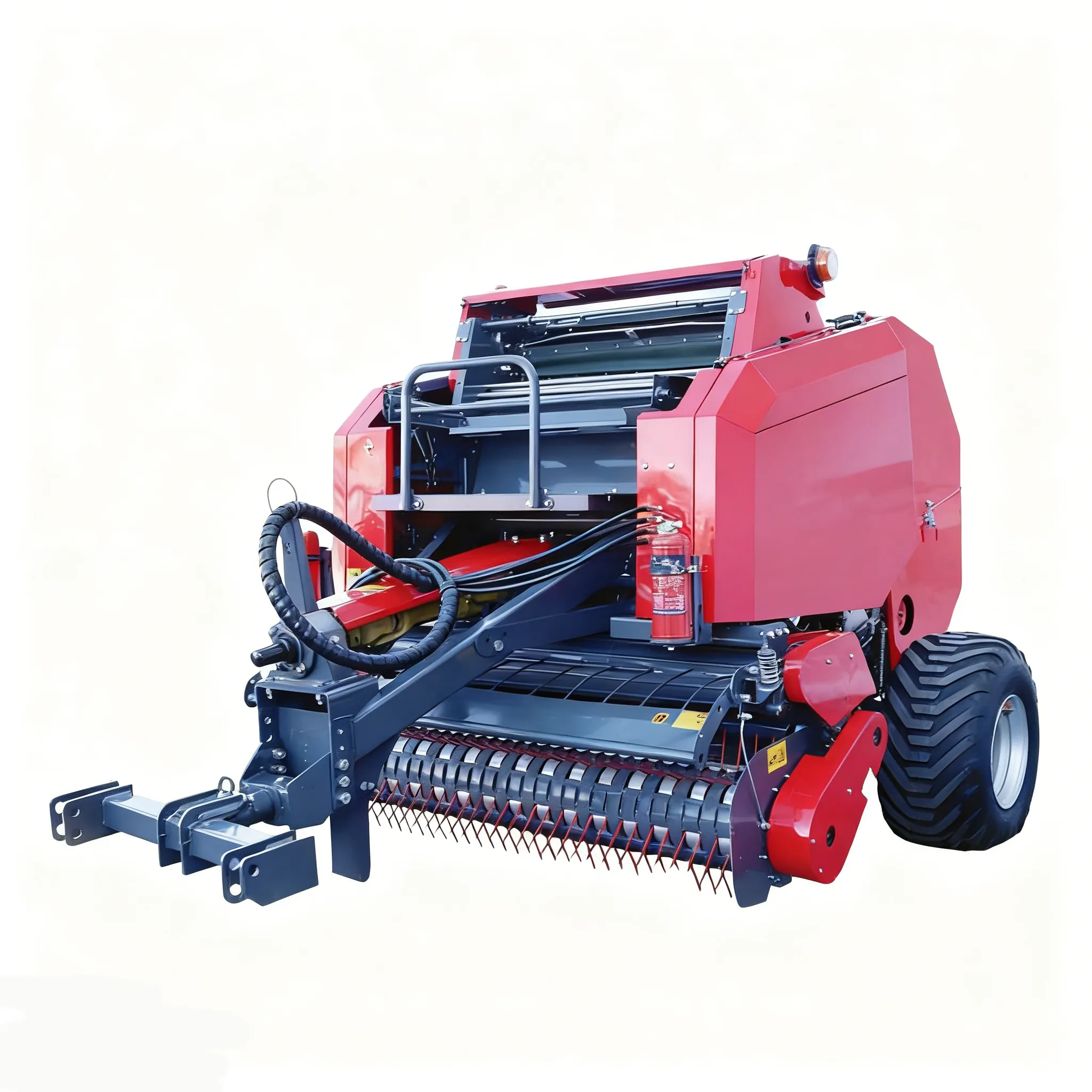
For smallholder-scale operations (2 to 15 hectares per season), the 9YG-1.0 rundballepresser handles rice straw windrows at 35 to 50 hp tractor PTO power, producing compact bales of 0.8 to 1.0 m diameter suitable for manual or small front-loader handling. This format is the standard for smallholder rice straw baling in Vietnam and southern China’s smallholder farming regions. For mid-scale operations (15 to 80 hectares per season) and commercial contractor operations, the 9YG-1.25A rundballepresser med variabelt kammer provides the higher throughput, consistent bale diameter, and chamber pressure control needed for substrate-grade supply contracts where bale weight consistency is a contract specification. For substrate buyers who specify 1.0 to 1.1 m bale diameter for their automated processing lines, the 9YG-1.0 specification bale format is often contractually required.
Where urea-treated fermented rice straw or silage-film wrapped substrate bales are produced — a growing application in substrate supply chains that want pre-fermented rather than raw straw — the 9YCM-850 bundtningsfilmindpakningsmaskine applies the 6 to 8 layers of silage film required for reliable anaerobic treatment, with programmable revolution control that ensures consistent layer count across high-volume baling days.
Operational Checklist: Getting Every Rice Straw Bale Right
Walk the field 3 days after combine harvest and assess windrow moisture by feel at the windrow base. If clearly above 25%, rake into wider windrow to speed drying. If below 22% at base, prepare baling equipment for deployment within 24 hours.
Rice field soils are fine-textured and prone to surface disturbance during pickup. Higher tine clearance than standard (5 cm for grass silage) is required to prevent soil entering the bale — particularly important for substrate-grade production where soil contamination is a zero-tolerance defect.
Rice straw dries unevenly — the surface reaches baling moisture 4 to 8 hours before the base layer. Always measure from 3 to 5 probe points at windrow base level before starting each session. Target: 14 to 18% for roughage, 14 to 15% for substrate-grade.
Rice straw windrows are typically lighter and lower-lying than grass windrows. Excessive speed causes pickup to miss straw or produce uneven bale density. Maintain a consistent 4 to 7 km/h and adjust for windrow weight variation across the field.
Net wrap maintains consistent bale diameter that automated substrate processing lines and mushroom factory conveyor systems require. It also reduces the risk of bale deformation during transport that can distort 1.0 m bales to oval cross-sections incompatible with round-bale handling equipment.
Mushroom substrate buyers increasingly require traceability documentation — harvest date, field identity, moisture at baling. Maintaining a simple log (date, field, bale count, measured moisture) protects against disputes when batches are delivered and inspected at the factory.
Common Mistakes and Quality Failures
Rice straw at 50 to 65% moisture forms a dense, wet mass in the bale chamber that cannot maintain aerobic conditions — it begins heating within 24 hours as microbial activity in the wet material consumes oxygen and releases heat. Within 3 to 5 days the core temperature exceeds 60°C, initiating thermophilic mould growth. The bale exterior may appear intact while the interior is actively composting. Such bales are not only worthless commercially — they are difficult to dispose of without creating exactly the pollution problem that baling was intended to solve.
Rice straw left in the windrow through a rain event re-wets to 35 to 50% and must be re-dried. In monsoon-season conditions where the next rainfall is 24 to 72 hours away, the effective drying window may be only 6 to 14 hours. Operations that do not immediately re-rake and re-aerate the windrow after rainfall to maximise drying in the available window find themselves in an escalating cycle of re-wetting and partial drying that ultimately requires baling above safe moisture. Having a rake or tedder immediately available during harvest season — not stored in the shed for a next-day deployment — is the operational requirement for wet-season rice straw management.
Even trace surface mould on rice straw bales delivered to a mushroom cultivation substrate facility will be detected by experienced substrate managers — they probe the bale surface and interior before acceptance. A single batch of mouldy bales delivered to a factory can contaminate the sterilisation room environment, spreading competitive mould spores to subsequent clean batches from other suppliers. Substrate buyers maintain supplier quality records, and a single rejection is typically followed by a 6 to 12 month exclusion from the supply programme.
Mushroom substrate supply is a specification business, not a negotiated commodity. Prices are set in advance in annual contracts based on bale specification, annual volume commitment, and delivery schedule. Arriving with bales that meet specification earns the contracted price; arriving with bales below specification earns rejection or a discount that may exceed the transport cost. Negotiate the specification and price before the baling season, not after delivery.
Ofte stillede spørgsmål
Discuss Your Rice Straw Baling Operation With Our Team
Tell us your harvest area, target market (roughage or mushroom substrate), and available tractor horsepower — we’ll specify the right baler and wrapper combination for your rice straw programme.