
Europe’s Highest-Yielding Energy Grass — and the Baling System That Gets It to the Boiler
Harvest timing, winter drying, bale density for transport economics, and the logistical chain from field to biorefinery across the UK, Germany, and Poland.
Miscanthus: The Perennial Energy Grass Reshaping European Biomass Supply
Miscanthus (Miscanthus × giganteus, the sterile hybrid most widely planted for biomass) is the highest-yielding perennial biomass crop grown in temperate climates. Established stands in the UK’s East Midlands, Germany’s Rhineland, and Poland’s Masovian lowlands produce 12 to 22 tonnes of dry matter per hectare per year — four to six times the yield of conventional arable crops on equivalent land and two to three times the biomass output of short-rotation coppice. Once established (year 3 onward), Miscanthus requires no annual replanting, minimal fertilisation (the crop efficiently recycles nutrients from senesced stems back to the rhizome in winter), and no pesticides under most European growing conditions. Its combination of high yield, low input, and 15 to 25 year stand persistence makes it one of the most cost-competitive dedicated energy crops in the European biomass market.
The relationship between Miscanthus and round bale silage equipment is not immediately obvious — Miscanthus is an energy crop, not a silage crop, and the final product is dry-baled biomass for combustion, not wrapped fermented silage. But the round baler is the standard harvesting format for Miscanthus in the UK, Germany, and Poland precisely because it produces a dense, compact, weather-resistant bale that can be stored outdoors in stacks for months and transported efficiently on standard agricultural trailers to biomass power stations. The bale format allows flexibility in offtake logistics that bundles and loose material cannot match. Understanding Miscanthus baling properly requires understanding the energy crop value chain it serves — and this guide covers that chain from field management through to bale quality specifications accepted by biomass buyers. Our overview of round baler vs square baler covers the format comparison relevant to biomass buyers who may specify either.
The Miscanthus Growth Cycle and Harvest Timing
Winter Senescence: The Key That Makes Baling Feasible
Miscanthus is a C4 grass with a distinctive seasonal physiology that makes its harvest timing completely different from most other crops. In autumn, as temperatures drop below 10°C in temperate Europe, Miscanthus transfers its nutrients — nitrogen, phosphorus, potassium — from the above-ground stem and leaf tissue back to the underground rhizome for winter storage. By December, the above-ground biomass is effectively dead plant material: dry, brown, standing at 2.5 to 4.0 m height with stems of 8 to 15 mm diameter, carrying moisture content of only 15 to 25% as natural field drying continues through the winter.
This natural winter drying means that Miscanthus harvested in January, February, or early March — after the crop has fully senesced and after several months of natural field drying — can be baled at 12 to 18% moisture without any additional drying, conditioning, or wilting. The crop essentially pre-dries itself in the field over a 4 to 5 month period. This is unique among high-yield biomass crops: sugarcane, short-rotation coppice, and annual energy crops all require active drying or can only be harvested in a narrow wet-season window. Miscanthus’s natural senescence provides the moisture management at no cost.
| Harvest Month | Moisture Content | Ash Content (DM) | Yield Retained | Baling Notes |
|---|---|---|---|---|
| October (before senescence) | 55–70% | 4–6% | Maximum | Too wet — not suitable |
| November–December | 30–45% | 3–5% | 95–98% | Still too wet in most years |
| January | 20–28% | 2–4% | 90–95% | Acceptable if weather dry |
| February ✓ | 15–20% | 2–3% | 88–92% | Optimal — standard UK/DE harvest |
| March | 12–16% | 2–3% | 85–90% | Good, some stem loss from weather |
| April+ | <12% | 2–3% | 75–85% | Excessive stem breakage |
Ash Content: Why February is Better Than Autumn
Ash content — the inorganic mineral residue after combustion — is a critical quality parameter for biomass buyers. High ash content reduces combustion efficiency and increases grate fouling in biomass boilers. Fresh October Miscanthus has 4 to 6% ash content because the leaves still carry their full mineral complement. After winter senescence and nutrient retranslocation, ash content falls to 2 to 3% in February-harvested material — among the lowest of any agricultural biomass feedstock. This low ash content, combined with a calorific value of 17 to 18 MJ/kg dry matter, makes winter-harvested Miscanthus one of the most combustion-efficient agricultural biomass materials available.
Baling Miscanthus: Equipment, Density, and Transport Economics
Why Bale Density Determines Transport Economics
Biomass supply chains are governed by logistics economics — the cost per unit of energy delivered from field to boiler is more important than the cost per tonne at the field gate. Bale density determines how much energy can be loaded onto a standard agricultural truck or biomass delivery trailer, and therefore directly affects the transport cost per GJ of energy delivered. A standard 13.6 m flat-bed truck carrying round bales can accommodate 18 to 24 bales of 1.25 m round bales depending on bale weight; the same truck can carry 28 to 36 bales if bale density is 30% higher.
The target bale density for Miscanthus is 160 to 200 kg DM/m³ — achievable with a variable-chamber round baler operating at maximum chamber pressure on dry February-harvested material. Below 140 kg DM/m³, transport economics become uncompetitive against other biomass formats (pellets, wood chip) in the distance ranges typical of UK and German biomass power catchment areas. Bale weight at 15% moisture and 180 kg DM/m³ density is 240 to 300 kg for a 1.25 m bale.
Equipment Specifications for Miscanthus
Miscanthus at February harvest moisture (15 to 18%) is a dry, brittle crop with stems that can cause pickup tine wear above that of grass silage but below corn stover levels. The key equipment consideration is chamber pressure capability — achieving the 160 to 200 kg DM/m³ target density from dry Miscanthus requires maximum chamber pressure and a consistent forward speed of 5 to 7 km/h. Net wrap is required over twine for all Miscanthus bales: the dry, stiff stems do not hold bale shape under twine binding tension, and bales tied with twine only can deform or loosen during handling and transport.
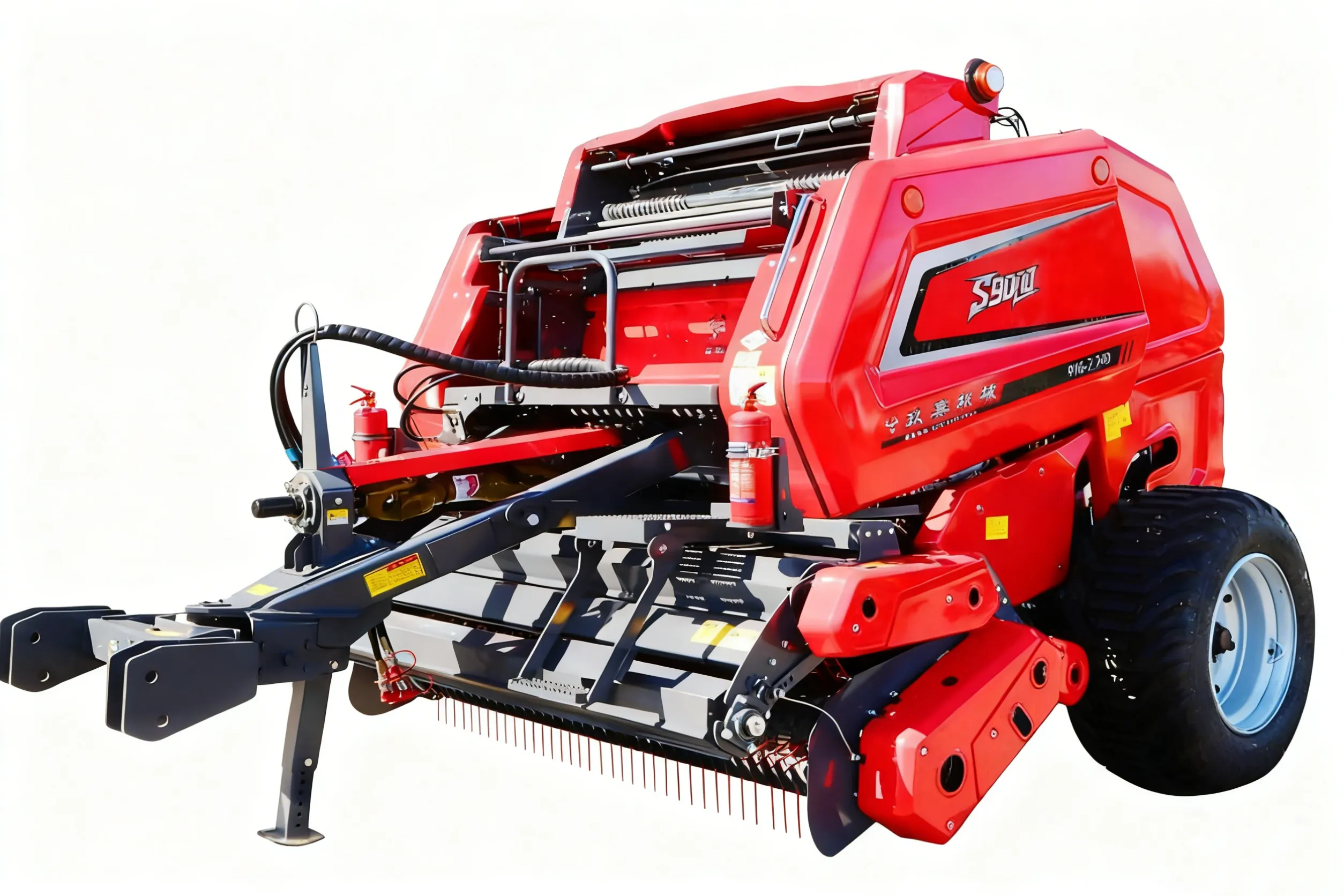
For commercial Miscanthus baling operations in the UK, Germany, and Poland where 50 to 200 hectares are harvested per season, the 9YG-1.25A ronde balenpers met variabele kamer provides the chamber pressure control and net wrap capability needed for consistent bale density in variable Miscanthus stand conditions. For contract harvesting operations covering 500+ hectares per season, the 9YG-2.24D S9000 Beyond ronde balenpers offers the higher throughput rate that tight harvest weather windows in January and February in northern Europe demand.
Biomass Quality Specifications and Buyer Requirements
What UK and German Biomass Power Buyers Specify
| Specificatie | UK Power Station | German CHP Plant | Consequence of Miss |
|---|---|---|---|
| Moisture | <20% | <18% | Reduced calorific value, fungal risk |
| Ash content | <5% | <4% | Grate fouling, efficiency loss |
| Calorific value (as received) | ≥13 MJ/kg | ≥14 MJ/kg | Price discount or rejection |
| Bale weight tolerance | ±10% | ±8% | Loading inefficiency, penalty |
| Foreign material | <1% | <0.5% | Contamination surcharge |
UK biomass power stations operating under the Renewables Obligation or Contracts for Difference subsidy schemes require sustainability certification for agricultural biomass — typically under the Sustainable Biomass Program (SBP) or the UK’s RTFO scheme. Miscanthus produced in the UK on non-converted land (land that was not forest or peat bog before Miscanthus planting) qualifies automatically under most certification schemes. Producers supplying certified biomass buyers need to maintain field records, carbon stock calculations, and chain of custody documentation that commercial certifiers review annually.
Miscanthus Stand Management and Long-Term Productivity
A well-established Miscanthus stand has an expected productive life of 15 to 25 years with minimal management inputs. The most important management practices for long-term productivity are: allowing the crop to fully senesce before harvest each winter (early harvest removes nutrients that would otherwise retranslocate to the rhizome, reducing next-year yield), applying potassium and occasional sulphur to stands on nutrient-deficient soils (potassium is the primary nutrient exported at harvest — nitrogen is almost entirely retranslocated), and controlling perennial grass weeds in the first 2 to 3 years before the Miscanthus canopy closes and suppresses weed competition naturally.
Stand establishment is the most critical and costly phase of Miscanthus production: rhizome planting costs £800 to £1,500 per hectare in the UK at 2025 input prices, and the stand takes 2 to 3 years to reach full yield potential. The economics over a 20-year stand life are strongly positive, but the upfront establishment cost means that most commercial UK and German Miscanthus plantings are done under long-term energy crop contracts with biomass power stations that provide establishment cost support or guaranteed price contracts of 10 to 15 years.
Veelgestelde vragen
Discuss Your Miscanthus Baling Requirements
Tell us your stand area, annual yield target, and biomass buyer specification — we’ll specify the right baler and bale density configuration for your energy crop supply chain.