
What Mould in Silage Bales Actually Is — and Why It Matters
Beyond the Visual — Understanding the Real Cost of Bale Mould
Mould growth in a silage baler-produced wrapped bale is the visible endpoint of an aerobic spoilage process that typically began well before the mould became visible. By the time white, grey, or blue-green patches appear on a silage face or on the film surface, the aerobic organisms responsible have already been consuming dry matter, generating heat, and in many cases producing mycotoxins for days, weeks, or months. The visible mould is only the surface expression of a process that has penetrated significantly deeper into the silage mass than the eye can see.
The direct costs of mould in silage bales are straightforward: dry matter consumption (the mould is literally eating the feed), heat generation that damages proteins through Maillard reactions reducing their rumen digestibility, and the production of mycotoxins — secondary metabolites from certain mould species that are toxic to livestock at various concentrations. The mycotoxin risk varies significantly by mould species. Fusarium species produce trichothecene and zearalenone mycotoxins; Aspergillus species can produce aflatoxins; Penicillium species produce roquefortine and other compounds. Not every mouldy bale contains hazardous mycotoxin concentrations, but some do — and the only way to know which is laboratory mycotoxin analysis. For high-production dairy cows and pregnant animals, feeding mouldy silage without mycotoxin testing is a health risk that can manifest as reduced milk production, reproductive failure, and immune suppression without obvious clinical signs attributable to the feed.
Understanding why mould occurs — and at which specific point in the system the failure happened — is the foundation of effective prevention. The following sections trace each root cause of bale mould to its intervention point, so that prevention can be applied where it is most effective rather than as a general improvement to everything simultaneously. For more about the silage equipment that creates the bales this guide protects, visit the Ever-power product pages.
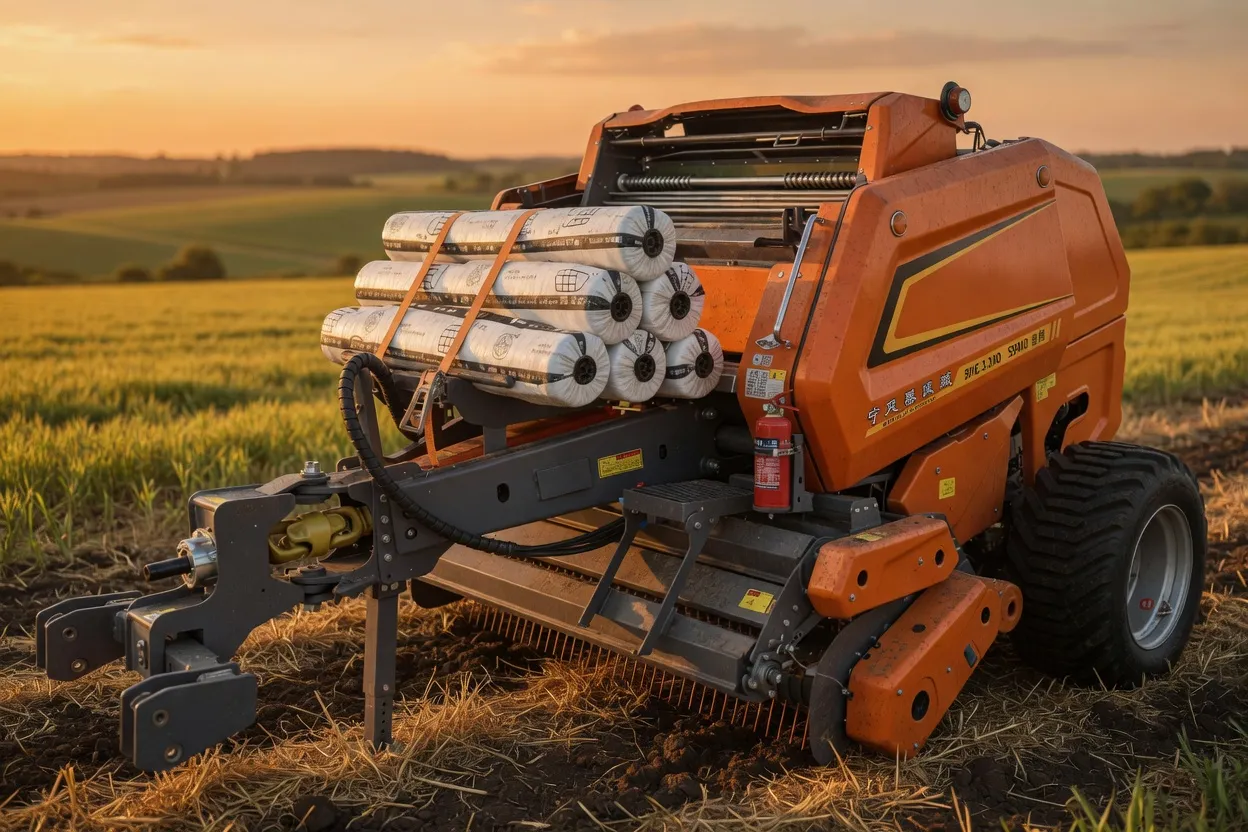
Root Cause #1 — Insufficient Bale Density
How a Loose Bale Creates the Oxygen Reservoir That Feeds Mould
A low-density bale contains more interstitial air per unit of dry matter than a high-density bale — and that air is the oxygen reservoir that sustains mould growth during the critical post-wrapping period. After wrapping, residual microbial respiration in the bale uses oxygen from this interstitial air to produce CO₂. In a high-density bale, the small volume of trapped air is exhausted quickly — typically within 12–24 hours — and anaerobic conditions are established before significant mould colonisation can occur. In a low-density bale, the larger air volume takes proportionally longer to exhaust, extending the aerobic phase during which mould spores present on the crop surface can germinate and begin colonising the silage mass.
This is why bale density is the most important mould prevention factor at the production stage — it directly controls the duration of the aerobic window after wrapping. A 10% improvement in bale density can reduce the aerobic phase duration by 20–40%, which is often the difference between mould colonies that are too small and slow-growing to cause significant damage and mould colonies that have established enough population to be visible and actively damaging by the time the bale is opened for feeding. The correct chamber pressure setting, matched travel speed, and consistent windrow density are the three levers that control bale density — together they can reliably achieve 185–205 kg DM/m³ in well-operated variable chamber machines. For silage baler machine advice, contact the Charlton team.
✅ Prevention: Density
- Set chamber pressure to silage specification — not hay setting — at the start of each silage session.
- Reduce travel speed by 20–30% below standard to allow even stuffer charges and uniform density.
- Confirm density with the firmness test: hand pressure should produce minimal surface deflection on the first three bales of every session.
- Use a variable chamber baler with precise pressure control for maximum density across variable moisture conditions.
Root Cause #2 — Extended Baling-to-Wrapping Interval
The Pre-Wrapping Window Where Mould Gets Its Head Start
Mould spores are ubiquitous in the farming environment — they are present on the crop surface, in the air, and on the silage baler itself. During the period between baling and wrapping, these spores have access to oxygen and moisture on the bale surface, ideal conditions for germination. A bale that sits unwrapped for four hours at 25°C has already accumulated a significantly larger population of germinated mould than a bale wrapped within an hour — and those established colonies survive into the wrapped bale, becoming the mould visible at the feed face weeks or months later even though the bale was correctly wrapped after the delay.
Research consistently shows that silage wrapped within one to two hours of baling has significantly lower mould counts at feed-out than equivalent silage wrapped after four or more hours, regardless of wrap layer count. This is because wrapping cannot undo the mould establishment that occurred during the pre-wrap aerobic window — it only prevents further establishment after the film is applied. The pre-wrapping aerobic window is the point at which mould prevention is most cost-effective: a faster wrapping routine costs nothing extra in materials but delivers a significant reduction in mould risk that no amount of additional wrap layers can fully replicate.
✅ Prevention: Wrapping Interval
- Target wrapping within 1–2 hours of baling — 4 hours is the absolute maximum in cool conditions.
- In hot weather (above 28°C) or high-moisture conditions, reduce the target to 60–90 minutes.
- Match wrapper capacity to baler throughput — if the wrapper cannot keep pace, reduce baler throughput rather than accumulating an unwrapped bale queue.
- Consider a baler-wrapper combination unit that wraps within 30–60 seconds of baling.
Root Cause #3 — Too Few Wrap Layers or Poor Overlap
When the Film Barrier Is Too Thin to Stop Oxygen Over a Storage Period
Stretch film creates the anaerobic barrier that preserves silage — but thin or incorrectly applied film allows oxygen to diffuse slowly through it throughout the storage period, sustaining low-level aerobic activity and mould growth even in a bale with no visible film breach. Four layers of 25-micron film is the minimum, but in Australian conditions — with high UV intensity, long storage periods, and the bird pressure that creates micro-breach risks — six layers should be the default. At fewer than four layers with 50% overlap, the oxygen transmission rate through the film barrier is high enough to sustain visible mould growth on the bale surface over a 6–12 month storage period even without a specific puncture event.
Poor overlap is an equally significant but less visible problem. Overlap of 50% means each point on the bale is covered by two film passes per layer — at 33% overlap, the effective coverage is only 1.5 passes per layer, reducing the total film thickness by 25% and proportionally increasing oxygen transmission. Many operators reduce overlap to extend film rolls without realising the quality impact. Check the wrapper overlap setting at the start of every session — 50–55% is the correct range. For information about the 9YCM-850 wrapping unit paired with Ever-power balers, see the product page.
✅ Prevention: Layers and Overlap
- Use 6 layers as the Australian default — 8 layers for high-moisture crop, long storage, or high bird-pressure sites.
- Set wrapper to 50–55% overlap and verify by measurement on the first bale of each session.
- Never reduce overlap to extend a roll — replace the roll and maintain specification.
- Use UV-stabilised film rated for 18+ months Australian outdoor storage.
Root Cause #4 — Film Punctures and Breaches During Storage
The Most Common Cause of Concentrated Mould Growth in Otherwise Well-Made Bales
A correctly wrapped, high-density bale that develops mould in a concentrated patch on the film surface or at the feed face almost always has a specific film breach as the cause. Birds — particularly cockatoos and crows in Australian conditions — peck through film with their beaks to investigate the contents, creating small round holes 5–15mm in diameter. These holes allow oxygen to enter continuously throughout the storage period, sustaining mould growth in the area adjacent to the hole. By the time the bale is opened, a single bird-peck hole that was not repaired within a few days of its creation can have a mould zone 20–40 cm in diameter behind the film surface — invisible from the outside until the bale is cut open.
Ground-level film damage from stubble, stones, or wire under the bale base creates a different pattern — mould concentrated at the lowest point of the bale, where the film was punctured against the sharp ground material and oxygen has entered through the base throughout the storage period. This type of damage is particularly insidious because the base of the bale is the most difficult area to inspect without physically lifting and examining the contact surface. Site preparation before the first bale arrives — clearing all sharp material from the ground surface — eliminates this entire damage category before it can occur.
✅ Prevention: Film Breach
- Clear all stubble, wire, stones, and sharp debris from the storage site before bales arrive.
- Install bird netting over bale rows or rotate active deterrents every 2–3 weeks to prevent habituation.
- Inspect every bale monthly (fortnightly in Oct–Mar) — carry silage repair tape and repair breaches immediately upon discovery.
- Use 8 layers in high bird-pressure sites to increase puncture resistance from beak strike.
- Fence out all livestock — cattle rubbing creates multi-bale film damage events.
Root Cause #5 — UV Film Degradation Over Long Storage
When the Film Itself Becomes the Oxygen Entry Point
Standard silage stretch film degrades progressively under UV radiation, and as it degrades its oxygen barrier performance declines — not through specific punctures but through a generalised increase in gas permeability across the entire film surface. In Australian conditions, film stored outdoors in direct sun for more than 12–15 months may have degraded to the point where it allows enough oxygen diffusion across its surface to sustain surface mould growth even without any specific damage event. This type of mould typically presents as a generalised, diffuse growth across the sun-exposed upper surface of the bale rather than the concentrated patches associated with specific breach events.
The thumbnail-press test is the most practical field method for detecting UV-degraded film before mould has become visible: press the thumbnail firmly into the top film surface. Healthy film resists this pressure and returns to shape without cracking; UV-degraded film will crack at the pressure point, split, or leave a permanent indentation. Bales showing these film degradation signs should be fed out as a priority, before the barrier failure progresses to visible mould. For the complete Ever-power silage system range, visit our About page.
✅ Prevention: UV Degradation
- Specify UV-stabilised film rated for 18+ months outdoor Australian storage — not just “UV stabilised” without duration rating.
- For bales stored beyond 12 months, covered storage under shadecloth or a shed roof extends effective film life by 30–50%.
- Monitor film condition with the thumbnail-press test at monthly inspections — prioritise film-degraded bales for early feed-out.
- Use 8 layers for all bales expected to be stored beyond 15 months — additional thickness compensates for progressive barrier thinning.
Root Cause #6 — Baling at Too-High Moisture
How Wet Crop Creates the Conditions for Mould Before the Bale Is Even Sealed
Crop baled above 70% moisture produces bales that are physically more susceptible to mould growth for two compounding reasons. First, the excess free moisture on the bale surface reduces the adhesion of the first film layers applied by the wrapper — when film is applied over a wet surface, micro-gaps between film and crop are more numerous, maintaining small oxygen reservoirs under the film that sustain localised mould growth even in an otherwise intact wrap. Second, the high moisture content dilutes the soluble sugar concentration that lactic acid bacteria require for fermentation, slowing the pH drop toward the preservation threshold and extending the period during which the aerobic organisms (including mould) can grow before acid conditions inhibit them.
The result in very wet bales is often a pattern of mould that develops at the bale surface even when the film appears intact — because the surface micro-gaps from poor film-to-crop adhesion on wet material created localised oxygen retention zones. This mould type is particularly difficult to prevent by wrapping alone, because the adhesion problem is structural and cannot be resolved by adding more layers. The prevention is moisture management at the source: measure with a forage moisture meter before baling, and wait until moisture is below 65% before deploying the baler. A two-hour delay for further wilting costs far less than the DM loss and mycotoxin risk from a batch of mouldy bales. For silage baler for dairy farm guidance matched to your scale, contact our team.
Diagnosing Mould: Match the Pattern to the Cause
Where the Mould Appears Tells You Where the Failure Occurred
| Mould Pattern | Most Likely Root Cause | Prevention Focus |
|---|---|---|
| Concentrated patch on top surface with small hole | Bird-peck film puncture | Bird deterrence, 8 layers, monthly inspection |
| Concentrated mould at bale base | Sharp ground material puncture | Site preparation — clear all sharp debris |
| Diffuse surface mould across upper film | UV film degradation (long storage) | UV-rated film, covered storage, priority feed-out |
| Mould throughout bale face at feed-out | Low density + long pre-wrap interval | Increase density + reduce wrapping interval |
| Surface mould at film-bale contact points | Wet crop — poor film adhesion | Reduce moisture to <65% before baling |
| Consistent mould across whole batch | Insufficient layers or overlap for conditions | Increase to 6–8 layers; verify 50% overlap |
Ever-Power: Bale Density That Fights Mould at the Source
How Equipment Choice Affects Mould Risk at the Fundamental Level

Mould prevention begins at the baler. The variable chamber pressure system in Ever-power’s S-series machines is the mechanical implementation of density control — it is not just a convenience feature but the direct means by which operators can push bale density into the range where aerobic oxygen is exhausted fast enough after wrapping to prevent significant mould establishment. The precision-machined roller surfaces in these machines produce the smooth, consistent bale shape that gives film the closest possible contact to the bale surface — reducing the micro-gap oxygen retention at bale surface irregularities that creates the local mould growth zones visible at feed-out. For a silage baler for sale in Australia that addresses mould risk at the production stage, the Charlton team recommends the right model for your volume and crop type.
Dealing With Mouldy Silage Bales?
Get a Diagnosis and Prevention Plan
Charlton Industrial Area, Australia — mould root-cause diagnosis, wrapping system advice, and equipment recommendations for Australian operations.

Frequently Asked Questions
Common Questions About Silage Bale Mould

Australia Ever-power Forage Balers Co., Ltd.
📍 Charlton Industrial Area, Australia