produk
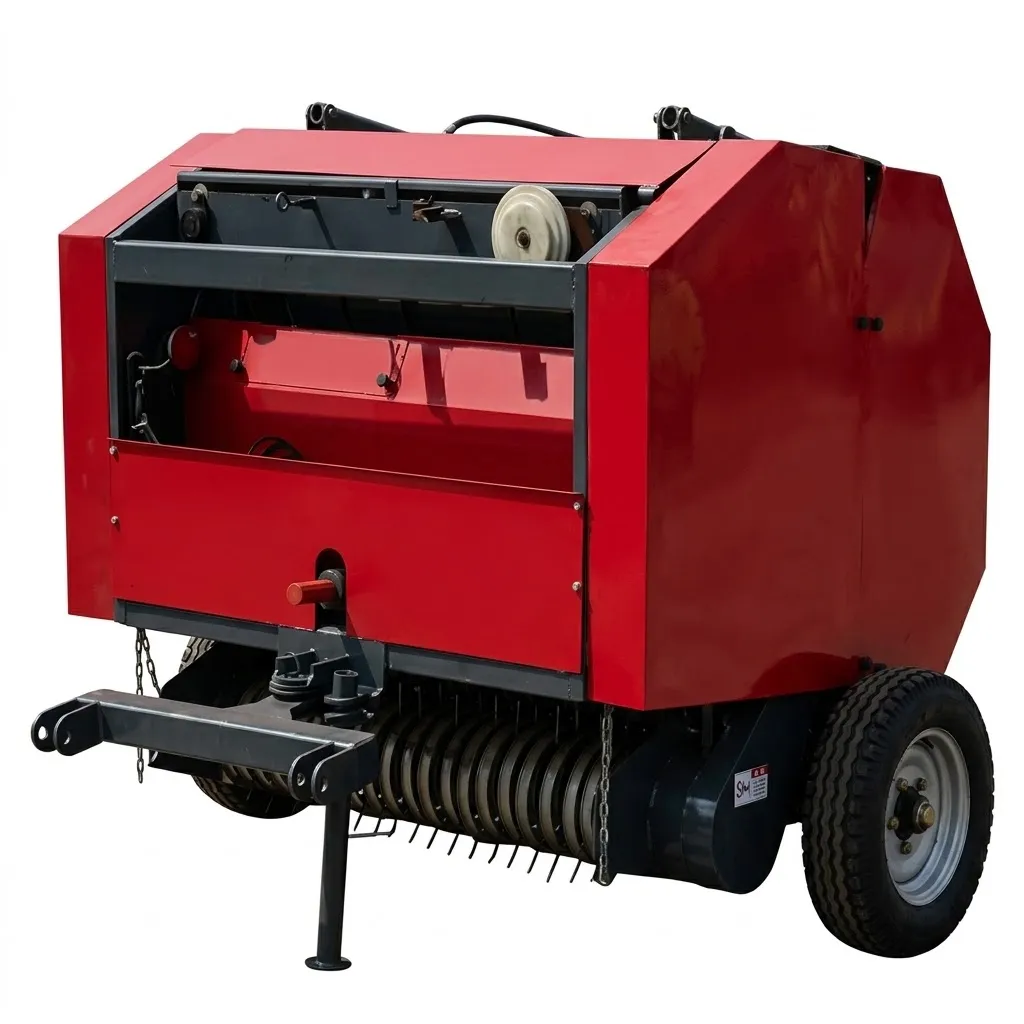
9YQ-1250 Ronde Hooibaler — Invoerroldrom, Φ800mm, Touwikkeling, 55–80 pk
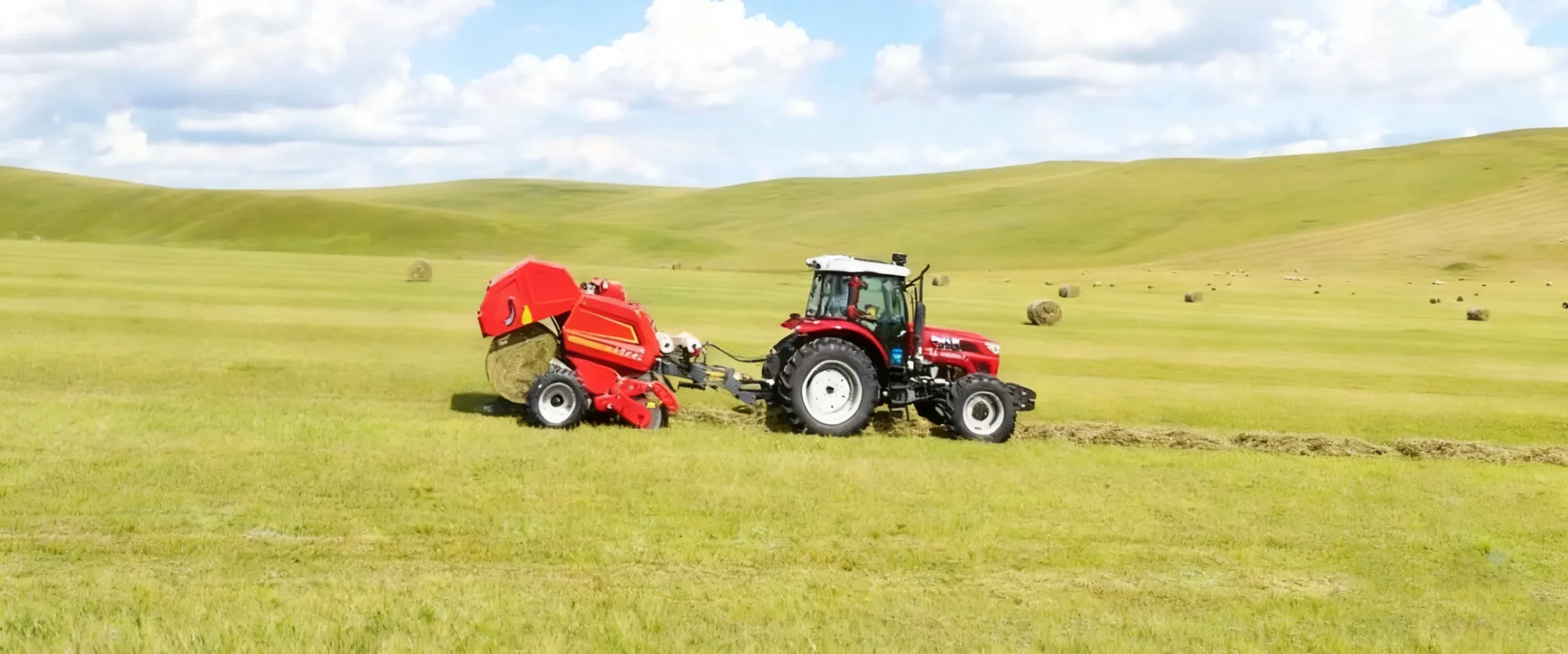
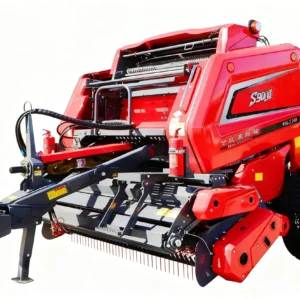
The 9YQ-1250 brings roll drum compression to small farm scale — a 1000 kg trailed baler with a 1250 mm spring-tooth pickup, 16-roller Φ800 mm fixed-diameter chamber, and rope wrapping. Running from 40.4–60 kW (55–80 hp), it suits small livestock farms, sheep holdings, and mixed operations baling dry oaten hay, ryegrass, or pasture where roll drum density consistency matters but machine weight and cost must stay manageable.
Roll Drum Bale Quality at 1000 kg — The 9YQ-1250 for Small Farms That Want More Than a Belt Baler
There is a gap in most round baler ranges between the large-scale machines that deliver the best bale quality and the small, inexpensive machines that small farms can actually afford and pair with their tractors. The 9YQ-1250 is designed to close that gap. At 1000 kg and 40.4–60 kW (approximately 55–80 hp), it is the lightest net-wrap-capable roll drum baler in the Ever-power range — bringing the core advantage of fixed-diameter roller compression to farms and operations that a heavier machine would exclude on cost, tractor size, or transport practicality.
The mechanical approach is deliberately simple. Spring tooth direct feeding carries picked-up crop straight from the 1250 mm reel into the roll drum compression chamber — no fork stage, no screw stage in between. At 1250 mm pickup width and the crop volumes this machine processes per cycle, that simpler path is adequate and appropriate: the surge-buffering function of a dual-stage feeder is a solution to a volume problem that does not arise at this machine's operational scale. Sixteen Φ152 mm hardened steel rollers form the Φ800 mm compression zone within a 1250 mm chamber width, producing rope-wrapped bales with the density uniformity that roll drum geometry delivers regardless of machine size. For guidance on choosing between a forage baler for small farms, our article on Watter grootte voerbaler pas by 'n klein plaas covers the key decision factors in detail.
Rope wrapping — rather than net wrap — is used on the 9YQ-1250. Rope costs substantially less per bale than net wrap and the tying mechanism is the simplest in the round baler range. For a small farm producing dry hay below 20% moisture, rope wrapping delivers bales that store and handle reliably without the per-bale cost that net wrap introduces. Australia Ever-power Forage Balers Co., Ltd. supplies this machine direct from Charlton Industrial Area, with Australian spare parts stock for all wear items.
Volledige tegniese spesifikasies
Full technical documentation and spare parts catalogue on request — kontak ons span.
What Small Farms Actually Need From a Round Baler — and Why Most Options Miss the Mark
Small farms with 50–80 hp tractors have two options in most round baler ranges: an inexpensive belt-drive machine that produces variable-quality bales, or a step up to a heavier roll drum machine that exceeds what their tractor can power or their budget can justify. The 9YQ-1250 is a third option — roll drum compression at 1000 kg and 40.4–60 kW, sized specifically for the farm that has outgrown the first category but cannot justify the second.
Cheap Belt-Drive Balers
Variable bale density from belt slip and growing-bale compression variation. Belts require planned replacement every 1–3 seasons. In wet or damp hay conditions, belt performance degrades further. Adequate for casual dry hay use, but the bale quality ceiling is lower than roll drum designs at any scale.
Oversized Roll Drum Machines
The 9YQ-1950 and 9YQ-2300 require 50–80 hp minimum and weigh 2385–2500 kg. For a small farm with a 60 hp tractor and a paddock that produces 200 bales per season, the machine weight, transport complexity, and capital cost all exceed what the operation genuinely requires.
9YQ-1250 — Roll Drum at the Right Scale
1000 kg, 55–80 hp, 16-roller Φ800 mm roll drum chamber. The fixed-diameter compression geometry produces more consistent bale density than any belt-drive alternative at this price point. Rope wrapping keeps consumable cost lower than net-wrap machines. Simple direct spring-tooth feeding has fewer failure points than dual-stage alternatives at this scale.
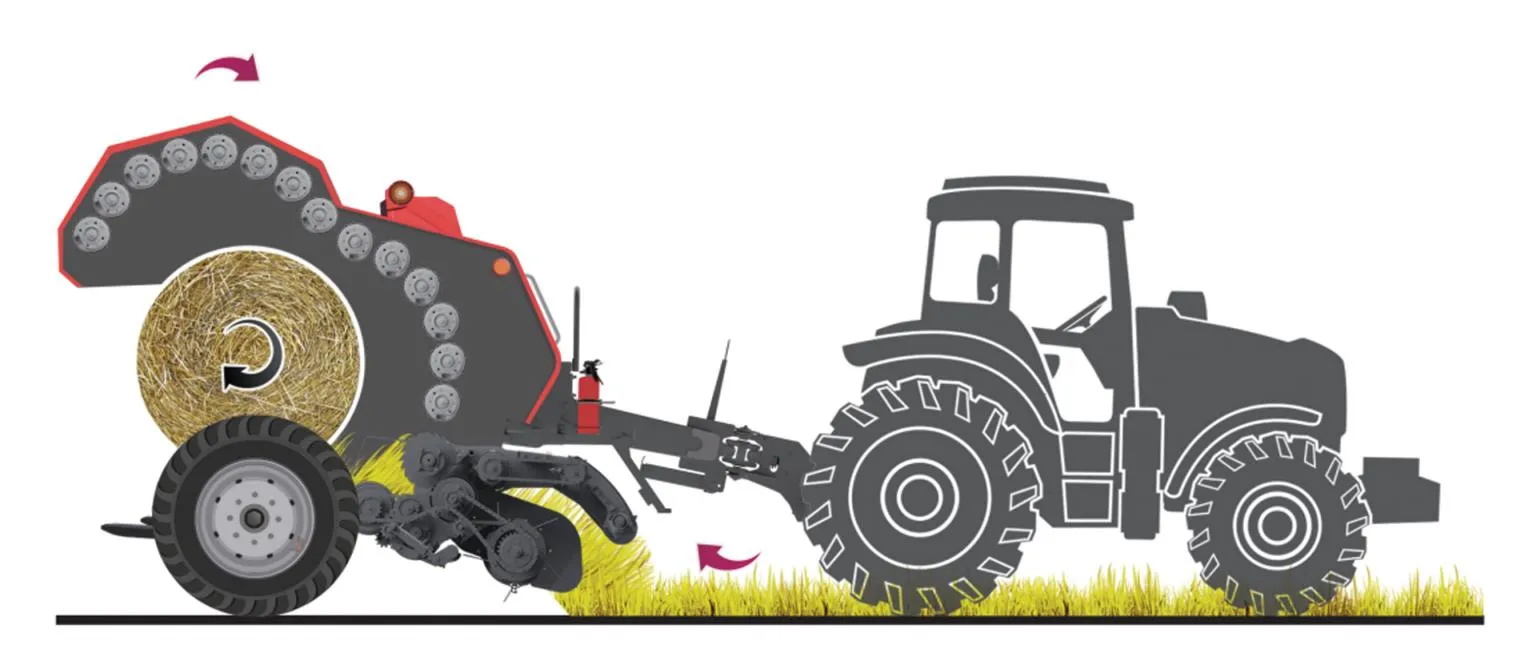
Simple Where Simplicity Is Right — Effective Where It Counts
The 9YQ-1250's mechanical design reflects a deliberate principle: at this scale and this crop volume, fewer components means fewer failure points, lower maintenance cost, and simpler field operation without sacrificing the bale quality outcome that roll drum compression delivers.
1250 mm Spring-Tooth Direct Feed — The Right Mechanism for This Scale
The spring-tooth pickup carries crop directly from the 1250 mm reel into the compression chamber without a secondary fork stage or screw feeder in between. This is not a cost-cutting simplification — it is a correct design choice for the crop volumes a 1250 mm pickup presents per machine cycle. The dual-stage feeder in the 9YQ-1950 and 9YQ-2300 exists because those machines' wider reels deliver surge volumes that need pre-metering before they reach the screw. At 1250 mm, that surge volume does not arise — the spring tines deliver a manageable flow directly into the chamber at the crop densities this machine is designed to handle.
Fewer components — fewer field stoppage causes
A small farm operator managing the baling operation largely alone benefits directly from mechanical simplicity. Each additional mechanism in the feed path is a potential blockage point, a bearing to grease, and a wear part to monitor. The 9YQ-1250's direct-feed design means the feed path has one mechanism rather than two — and every simplification in a solo baling operation is a practical advantage that compounds across a full seasonal run.
16-Roller Roll Drum Chamber — Φ800 mm Fixed Bale Every Time
Sixteen Φ152 mm hardened steel rollers form the fixed-diameter Φ800 mm compression zone within a 1250 mm chamber width. The fixed geometry means every bale forms under the same radial compression force from the first material entry to the rope-tying trigger — no compression variation as bale size increases, no belt slip events introducing density irregularity mid-cycle. This is the fundamental advantage of roll drum design regardless of machine size: the bale that comes out of a 16-roller chamber at Φ800 mm has more consistent core-to-surface density than a variable-chamber belt bale of the same diameter.
Φ800 mm — a bale size with practical small-farm advantages
The Φ800 mm bale is smaller and lighter than the Φ1000 mm bales from the 9YQ-1950 and 9YQ-2300. In light to medium cured hay, a Φ800 mm rope-tied bale can be moved by two people without loader assistance — relevant on small farms where a front-end loader is not always available or attached when bales need to be moved for feedout. For storage, the smaller diameter allows more bales per shed row at the same ceiling height, and stacking two high is more practical and safer than with larger formats.
Rope Wrapping — The Correct Tying Method for Dry Hay at This Scale
Rope wrapping is the right choice for the 9YQ-1250's application: dry hay below 20% moisture, at the seasonal volumes a small farm produces. Rope costs significantly less per bale than net wrap — the difference is meaningful across a season of several hundred bales, and more so across the machine's full working life. The rope-tying mechanism is also mechanically simpler than a net-wrap cut-and-clamp system, with fewer components to monitor and fewer potential failure modes to manage in the field.
When rope wrapping is not suitable
Rope-tied bales are not suitable for high-moisture silage applications. Bales at 50–70% crop moisture are soft on ejection and will slump without the circumferential compression that net wrap provides. For silage baling with subsequent film wrapping, the net-wrap machines in our range — the 9YQ-1950, 9YQ-2300, and 9YG-2.2 — are the appropriate choices. The 9YQ-1250 is a dry hay baler; its rope-wrapping design reflects that clearly defined application.
40.4–60 kW — Runs From the Farm's Existing 55 hp Tractor
The 40.4 kW minimum is approximately 55 hp at the PTO shaft — the common size range of smaller four-wheel-drive tractors used on Australian small farms for cultivation, spraying, and general property work. The 9YQ-1250 is designed to pair with that tractor without requiring a separate baling-specific machine. The 60 kW upper limit (approximately 80 hp) accommodates slightly larger tractors that may be available on the property for other tasks, all within the machine's rated operating envelope.
Operating within rated power — why it matters
Running the 9YQ-1250 from a 55 hp tractor in light dry hay windrows is comfortable and productive. In heavier windrows — denser oaten hay, thick ryegrass cut at moderate moisture — a tractor closer to the 70–80 hp upper end of the range maintains better PTO speed stability under load, producing more consistent bale formation on each cycle. Confirm your tractor's PTO horsepower output — not just engine horsepower — with our team before purchasing.
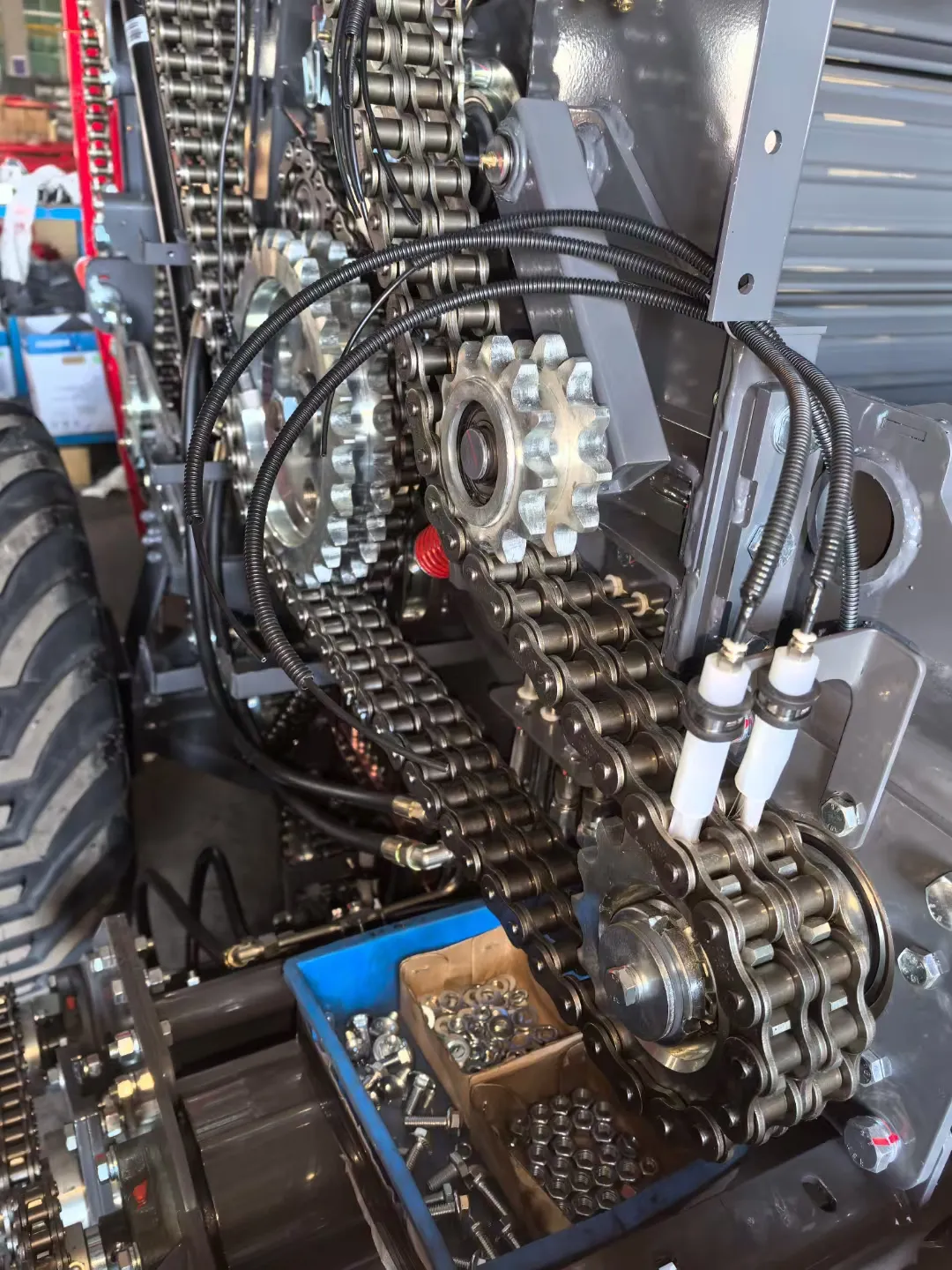
Where the 9YQ-1250 Sits in the Ever-power Round Baler Range
The 9YQ-1250 is the entry point for roll drum baling in the Ever-power range — sitting between the ultra-compact 9YK-870 below and the dual-stage-fed 9YQ-1950 above. The table below shows where each machine fits.
✓
✓
✓
✓
✓
→
→
→
→
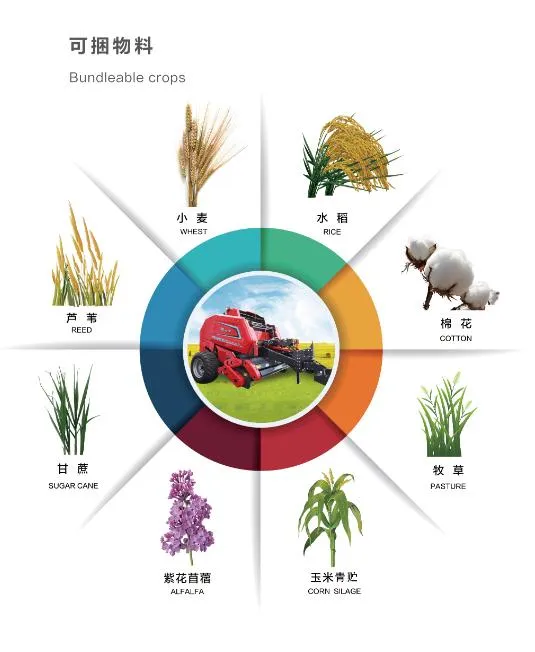
Getting the Best from the 9YQ-1250 Each Hay Season
The 9YQ-1250's simpler mechanical design reduces the daily maintenance checkpoints versus dual-stage machines — but the fundamentals of correct baling practice remain the primary determinant of seasonal output quality.
Bale Strictly Below 18% Moisture
Rope-tied bales are less tolerant of elevated moisture than net-wrapped bales. Hay above 18% moisture in a rope-tied compact bale will heat during storage — reducing nutritional value, shortening storage life, and in severe cases creating a fire risk in a shed stack. Use a hand-held hay moisture meter to confirm curing before baling. On a day with cloud or humidity near the end of the curing window, wait 24 hours rather than risk an entire barn of heating bales.
Rake Windrows to 1250 mm Before Baling
Most small disc mowers and mower-conditioners produce windrows wider than 1250 mm. Before baling with the 9YQ-1250, rake or merge windrows to approximately 1250 mm width. Running a 1250 mm reel over a 1600 mm windrow leaves 350 mm of crop uncollected on both passes — that material is either re-baled in a second pass or left in the field. A simple rake pass before baling eliminates this loss and ensures every bale is a full-weight bale.
Inspect the Rope Tying Mechanism Before Each Session
Check the rope routing path, bill hook timing, twine guide condition, and spool level before the first bale of each session. An untied bale discovered mid-field on a small farm — where the operator may also be handling bales alone — is more disruptive than in a large operation with crew support. A two-minute pre-run check prevents the common knot-skip failures that arise from a worn guide surface or misrouted rope, and costs far less time than correcting an untied bale in the paddock.
Pre-Season Check — All 16 Rollers
Before the first bale of each season, inspect all 16 compression rollers for bearing play, surface wear, and correct axial positioning across the 1250 mm chamber width. A roller with elevated bearing play produces a soft band around the bale at its angular position — detectable by pressing the ejected bale surface but not correctable in the field. Pre-season inspection catches this before it affects the full seasonal batch of bales. Roller bearing replacement is the primary compression-zone maintenance event on this machine — addressing it pre-season keeps the full season's baling at specification.
Set Pickup Height for the Paddock Surface
Correct pickup height is the most impactful single setup decision for bale weight and quality on each paddock. Too low and tines drag soil into the direct-feed channel, contaminating bales and accelerating tine wear. Too high and fine-stemmed hay leaf material — the highest-nutritional-value part of the windrow — is left on the ground uncollected. Adjust height at the start of each new paddock and check again mid-field if soil conditions change noticeably across the paddock area.
Grease All Points — Fewer Points, Same Discipline
The 9YQ-1250 has fewer grease points than dual-stage machines — but consistent lubrication at the specified intervals is equally important. Grease reel shaft bearings, roller bearings, and PTO shaft joints at each fuel stop during seasonal baling runs. For a machine that may sit unused for months between seasons, grease all points immediately before storage and again before first use the following season — moisture ingress into dry bearing housings during extended rest periods is a common cause of premature bearing wear in seasonally-used balers.
Roll Drum Quality at Entry-Level Scale — Factory-Direct from Australia Ever-power
Australië Ever-power Voerbalperse Maatskappy, Bpk., Charlton Industriële Gebied. Oor ons besigheids- en voorsieningsmodel.
Manufacturer Price — No Distribution Markup
Small farm buyers are most sensitive to purchase price — and most exposed to distribution margin inflation in the agricultural equipment market. Ever-power's direct supply to Australia removes the importer and distributor layers that inflate the price of equivalent-quality machines in dealer channels. The 9YQ-1250's price reflects its production and delivery cost, not its position in a tiered product range with accumulated margin at each tier.
Australian Stock — Tines, Rollers, Rope Components
Spring pickup tines, roller bearings, and rope wrapping mechanism components for the 9YQ-1250 are held in Australian stock. For a machine used seasonally — perhaps for a few weeks per year — having locally available parts means a worn tine or rope component does not become a multi-week international freight problem that pushes the repair into the following season. We recommend a small on-hand spare parts kit with every machine purchase; contact us to discuss what to include for your specific crop types.
First-Buyer Setup Support Included
Many buyers of the 9YQ-1250 are operating a baler for the first time. Our Australian team provides setup guidance on pickup height, rope routing and tension, PTO connection, moisture requirements for rope-tied bales, and the pre-season roller inspection procedure — by phone and email in English. We account for first-buyer context in our support approach. Reach us at [email protected] of deur ons navraagvorm.
Gereelde vrae
Common questions from small farm owners and first-time baler buyers evaluating the 9YQ-1250.