
Post-harvest timing, moisture windows, nutritional value relative to corn stover and wheat straw, and the two markets — roughage and bedding — that make soybean stover baling profitable in China, Brazil, and the USA.
Why Soybean Stover Deserves More Attention Than It Gets
Soybean stover — the stems, leaves, pods, and petioles that remain after soybean combine harvest — is the most nutritionally valuable cereal-category crop residue routinely left in the field. Crude protein at 6 to 10% dry matter basis is 50 to 100% higher than equivalent wheat straw, rice straw, or corn stover, reflecting the legume nature of the soybean plant and the residual protein in stems, leaf material, and shattered pod fragments that remain after grain harvest. This protein advantage is not trivial: in a beef cattle growing ration where purchased protein supplement (soybean meal, cottonseed cake) costs ¥3,000 to ¥5,000 per tonne, replacing 15 to 20% of the supplement allocation with soybean stover roughage at its true protein value is a genuine ration cost saving.
China is the world’s third-largest soybean producer and the dominant consumer of imported soybeans. Heilongjiang province alone — China’s primary domestic soybean production zone — harvests 6 to 8 million tonnes of soybean grain annually, generating a roughly equivalent volume of stover. Brazil (the world’s largest soybean producer at 150+ million tonnes per year) and the USA (second-largest at 120+ million tonnes) together generate stover volumes that dwarf any other crop residue category. In all three countries, the majority of this material is either incorporated directly into the soil, burned under open-field conditions, or left to decompose — with only a small fraction baled for commercial use.
The barrier to baling has historically been practical rather than economic: soybean stover is a structurally difficult crop to bale cleanly. The brittle, fragile stems shatter readily when dry, the leaf and pod shell fraction is easily lost during raking and pickup, and the harvest timing window is narrow — the crop must be baled promptly after combine harvest before it becomes too dry to handle without excessive shatter. This guide covers every aspect of soybean stover baling: why the nutritional premium justifies extra management attention, the harvest window and moisture targets, baler configuration for the fragile material, and the comparison between roughage and bedding market channels. For producers managing multiple residue crops in the same season, our article on what a silage baler is and how it works covers equipment fundamentals relevant across all residue baling operations.

Nutritional Profile: The Legume Advantage Over Cereal Straws
| Residue | Crude Protein (DM) | NDF | TDN | Relative Feed Value |
|---|---|---|---|---|
| Soybean stover | 6–10% | 60–68% | 45–55% | Moderate roughage |
| Wheat straw | 3–5% | 70–78% | 38–50% | Low roughage |
| Rice straw | 2–4% | 60–72% | 35–48% | Very low roughage |
| Corn stover | 5–7% | 65–75% | 45–55% | Moderate roughage |
| Alfalfa hay | 18–22% | 40–48% | 58–65% | Premium forage (reference) |
The crude protein advantage of soybean stover over cereal straws is most pronounced in the leaf and pod shell fraction. Leaves and shattered pod shells carry 12 to 18% crude protein on a dry matter basis — comparable to poor-quality grass hay — while the stem fraction carries 4 to 6%. Operations that minimise leaf and pod shell loss during baling capture material that is significantly more nutritious per tonne than any cereal straw. Operations that lose most of the leaf fraction to shattering during raking and pickup end up with a lower-quality product comparable to corn stover at best.
Mixing Soybean Stover with Corn Silage or Corn Stover
A practical application in northern Chinese beef production systems is combining soybean stover (high protein, lower energy) with corn silage or corn stover (high energy, lower protein) in a total mixed ration. At 20 to 30% soybean stover DM + 30 to 40% corn silage DM + supplementary grain and mineral, the resulting ration approaches the crude protein specification needed for a 0.9 to 1.2 kg/day beef growing ration without purchasing additional protein supplement. The economic saving from reduced soybean meal purchase can be substantial in high-protein-price years.
The Harvest Window: Managing the Shattering Problem
Why Timing Is More Critical Than for Cereal Straws
Soybean stover shatter loss is more severe and more rapid than for wheat or corn stover. The brittle nature of dried soybean stems (the plant has no structural silica but is lignified and fragile when dry) combined with the tendency of dry pod shells and leaves to detach at any mechanical disturbance means that baling 10 days after harvest can result in 20 to 40% loss of the leaf and pod shell fraction versus baling at 4 to 7 days. This fraction contains the majority of the protein value — so delayed baling is not just a yield penalty, it is a protein value penalty.
| Days After Harvest | Stover Moisture | Leaf/Pod Retention | Crude Protein (DM) | Action |
|---|---|---|---|---|
| 0–2 days | 35–55% | High | 8–10% | Allow partial drying — too wet |
| 3–5 days | 18–30% | Excellent | 7–9% | Ideal — bale immediately |
| 6–8 days ✓ | 12–22% | Good | 6–8% | Good — bale this week |
| 9–12 days | 8–15% | Declining | 5–7% | Acceptable with care |
| >12 days | <12% | Poor | 4–5% | Significant shatter — emergency baling |
Weather and the Narrow Window
In China’s Heilongjiang and Jilin provinces, soybean harvest occurs in September and October. Post-harvest conditions are cooling rapidly, with increasing risk of early frosts and the first autumn rainfall. The soybean stover baling window — 3 to 10 days after harvest — frequently coincides with post-harvest rainfall in these provinces, which re-wets the stover and creates an additional 3 to 5 day wait before baling can resume. Operations that mobilise baling equipment within 24 hours of combine harvest complete — and maintain a 48 to 72 hour deployment readiness posture throughout harvest season — consistently capture better leaf retention and higher protein value than those who schedule baling as a secondary operation after other post-harvest tasks.
Baler Configuration for Soybean Stover
Pickup Settings to Minimise Leaf Loss
The most important baler setting for soybean stover is pickup tine height. Setting tines too high — above 8 cm — leaves significant leaf and pod shell material on the ground because these light, flat fragments do not rise into the pickup airstream reliably above this height. Setting tines too low — below 4 cm — scoops soil and stubble into the bale, contaminating the product and accelerating pickup wear. The target is 5 to 7 cm tine height, which captures the majority of the light leaf fraction while keeping soil contamination below 2 to 3% of bale weight.
Forward baling speed should be reduced to 4 to 6 km/h in soybean stover — significantly slower than the 8 to 10 km/h typical for grass silage. The low-density, fragile soybean stover windrow requires a gentler, steadier feed rate to prevent the pickup from flicking material into the air (causing leaf loss) and to prevent chamber pressure spikes that cause stover to compress unevenly and produce low-density bales with internal air pockets.
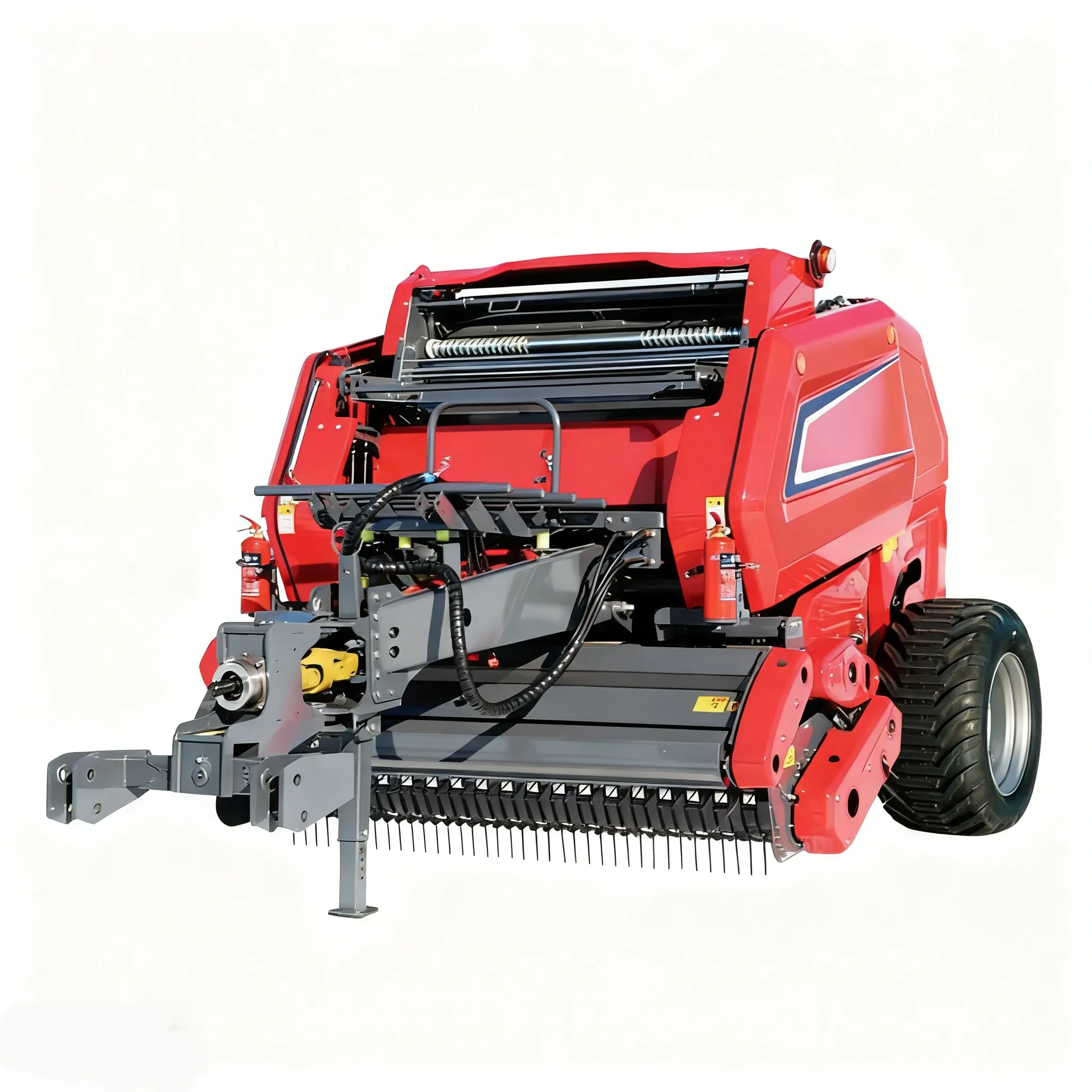
For soybean stover baling operations producing more than 50 bales per day, the 9YG-1.25A variable-chamber round baler provides the chamber pressure consistency that soybean stover’s variable windrow density requires. Net wrap is preferred over twine for any bales handled mechanically or stored outdoors — soybean stover bales are structurally weaker than cereal straw bales and deform under their own weight when twine binding provides insufficient peripheral tension.
Markets: Roughage, Bedding, and the China Soybean Belt
Roughage Market Pricing and Volume
In Heilongjiang and Jilin provinces, soybean stover bales sell for ¥100 to ¥180 per standard 1.25 m round bale at current market prices — a 20 to 40% premium above equivalent wheat straw bales in the same region, reflecting the crude protein advantage. Buyers are predominantly intensive beef cattle operations in Inner Mongolia and Hebei that operate TMR feeding systems and value consistent protein inputs. Sales are typically made through regional hay trading networks or direct to feedlot purchasing managers who contract for annual supply volumes.
Bedding Market — The Clean, Soft Alternative
Soybean stover has gained traction as livestock bedding in some markets, particularly for pig farrowing and nursery operations where a softer, more absorbent bedding material is preferred over coarse wheat straw. The shattered leaf and pod shell fraction that is a quality problem for roughage use is actually a quality advantage for bedding — it produces a finer, softer, more absorbent bed than intact cereal straw stems. For bedding market production, baling at 12 to 16% moisture with very low soil contamination (pickup tine height maintained at 6 to 7 cm throughout) is the specification that commands premium bedding pricing.
Frequently Asked Questions

Discuss Your Soybean Stover Baling Operation
Tell us your harvest area, available equipment, and target market — we’ll specify the right baler configuration for efficient soybean stover collection.